Monday, October 12, 2020

California Pinot Noir

"The smack of California earth shall linger on the palate of your grandson." Robert Louis Stevenson


The history of California Pinot Noir is spread over a number of decades, but only recently has the wine's popularity caught up with its impressive quality.  

In 1952, former ambassador James Zellerbach, planted a vineyard in the hills north of the town of Sonoma.  Zellerbach's goal was to make a Hanzell Pinot Noir in Sonoma county like those he had tasted in Burgundy's Cote d'Or. 

According to Leon Adams in "The Wines of America," Zellerbach never knew (he died in 1963) that his Hanzell wines changed the way vintners thought about the way California red wine tasted. According to Adams, Hanzell wines "would cause scores of America's leading vintners to make an important change in the flavor of their wines."

That "important change" was Zellerbach's introduction of French oak to California wine making, specifically for Chardonnay and Pinot Noir.  Before the introduction of French oak, California winemakers mostly used American white oak.

There were, of course, other dedicated folks who believed, in the face of consumer fervor for Cabernet Sauvignon, that there was a place in the Golden State for Pinot Noir. Those that shared Zellerbach's passion for red Burgundy included: Chalone, Navarro, Beaulieu Vineyard and Sanford and Benedict.  

Aside --There is a story that Andre Tchelistcheff, long-time winemaker for Beaulieu Vineyard, admitted once that Pinot Noir was his favorite red wine, even though he became known for B-V Private Reserve, one of Napa Valley's iconic Cabernet Sauvignons. 

The pinot advocates believed that to make Pinot Noir in California that shared some of the similarities to Burgundy, a cool climate was needed.
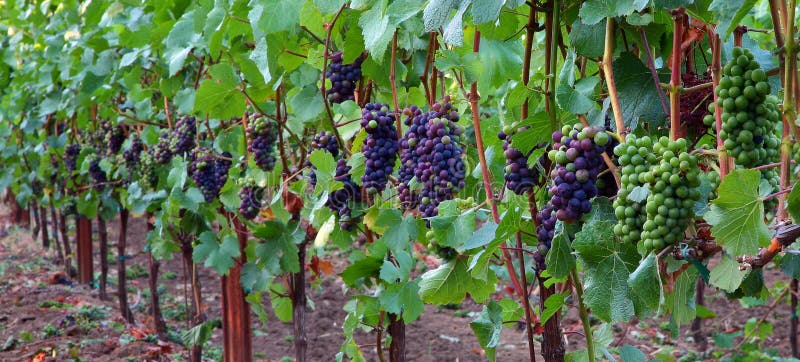
Panoramic of Pinot Noir Grapes. Panoramic view of Pinot Noir grapes during veraison in the Willamette Valley of Oregon royalty free stock images
Pinot Noir clusters all in a row           

In many ways, Pinot Noir is the antithesis of Cabernet Sauvignon. Pinot Noir demands far more of the grower than does Cabernet Sauvignon. Pinot Noir has a sensitivity to soils, while Cabernet will grow almost anywhere. Pinot Noir is notoriously difficult in the winery, whereas Cabernet Sauvignon is relatively easy to ferment.  And, an inexpensive Cabernet still tastes like Cabernet Sauvignon, while an inexpensive Pinot Noir is just another red wine.

And then there's this: Cabernet Sauvignon has a more defined and angular structure, while Pinot Noir tends to be more sensual, softer and rounder.  Think of Cabernet Sauvignon as a square and Pinot Noir a circle. 

This diversity is one of the telling features that separates California Pinot Noir, from Oregon and the few scattered places around the country where growers and winemakers strive to make a distinguished wine. It should be noted that identifying a specific location or terroir is no more noticeable than in Burgundy where red wine is identified as Burgundy and not Pinot Noir. 

Whatever the reasons why people are attracted to Pinot Noir, the fact is that an impressive number of California winemakers consider making Pinot Noir as the attainment of the wine Holy Grail. They may be making world-beating Cabernet Sauvignon, but what they want is the challenge of making a memorable Pinot Noir and the satisfaction of what has become known as "pinot envy."

 Where Pinot Grows Best

Like many things about Pinot Noir, summing up its flavor in a few words is an elusive exercise. The traditional descriptors like strawberry, black cherry, boiled beets, spice are only general, while leather, mushrooms and gamy fit more with aged Pinot Noir.  Traditionally, memorable California Pinot Noir came mainly from coastal vineyards, or vineyards near a body of water, helping to smooth the edges of climate extremes.  

The following general summary, alphabetical from north to south, may help to distinguish the pinots from one California region to another:

Anderson Valley -- The Anderson Valley, between Booneville and the Pacific Ocean, has nurtured a low-key reputation for excellent Pinot Noir. The maritime influence gives the wines bright raspberry flavors with floral accents. There are 60 wineries in this rural valley, including Husch, Goldeneye and Roederer Estate sparkling wine. Every May, the vintners hold a Pinot Noir Festival in the Anderson Valley.

Carneros -- The broad Carneros appellation lies across the southern ends of Napa and Sonoma counties, bordering San Pablo Bay, the northern part of the larger San Francisco Bay. The cooling marine influence allows Pinot Noir, for still and sparkling wines, to yield ripe fruit, with a spicy accent and crisp acidity.  A few producers: Etude, Saintsbury, Donum Estate and Domaine Carneros.  

Central Coast -- This is a catchall appellation that stretches from San Francisco to Los Angeles and includes San Benito, Paso Robles, San Luis Obispo, and Santa Lucia Highlands in Monterey County. With the possible exception of Paso Robles, there are noteworthy Pinot Noirs from the other areas, such as Calera (San Benito) and Belle Glos (Santa Lucia Highlands).

                                              Russian River Valley Wines | Gary Farrell Vineyards & Winer's collection of  10+ russian river valley ideas in 2020

Russian River Valley -- The wine part of the land where the river runs through it in northern Sonoma County, stretches from west of Healdsburg to where the river empties into the Pacific Ocean. Pinots are known for silky textures, soft tannins, dark cherry and a trace of minerals. A few producers: Williams Selyem, Hartford Court, David Ramey, Gary Farrell. 

Santa Barbara County -- Technically within the Central Coast AVA, the southern Santa Barbara County encompasses Santa Maria Valley, Santa Rita Hill and Santa Ynez Valley AVAs. Pinots range from lean and peppery to full and berry-rich. A few producers: Au Bon Climat (Santa Maria Valley), Sea Smoke (Santa Rita Hills), Gainey Vineyard (Santa Ynez Valley).

Sonoma Coast -- This vast and confusing appellation stretches for hundreds of miles along Sonoma's Pacific coast and includes the Fort Ross-Seaview appellation.  Although the Sonoma Coast AVA includes some inland areas, many of the vineyard best sites are among the coolest in the state. The pinots are known for bracing acidity, deep berry flavors and silky tannins. Producers: Fort Ross Vineyards, Flowers, Hartford Family, La Crema.

And finally, two end notes:                                                    

Caveat emptor:  Wildfires this year have done considerable damage to vineyards and wineries, especially in Northern California. Some wineries lost grapes in the fires, some lost case goods, others saw damage to their buildings. The full impact of smoke on grapes and wines is still unknown. The prospect of less wine, though, due to smoke-taint, will obviously put pressure on present stocks, undoubtedly affecting bottle prices.  

The Holiday Bird...With Thanksgiving just weeks away, it's time to think of what wine(s) to serve with the holiday meal.  Here's a suggestion from the Petaluma Gap Alliance, a winery group in Sonoma County, that polled their members who decided that Pinot Noir  (from the Petaluma Gap, hopefully) is the ideal choice with the traditional Thanksgiving feast.  I wholeheartedly agree.

                                                    -o0o-

Next blog: "My Life in Wine" Episode 7

Comments?  Suggestions?  Email me at boydvino707@gmail.com


Friday, October 2, 2020

How much is enough?

"In vino veritas -- In wine there is truth."  Words from Pliny the Elder that should be on all wine labels.


How much do consumers need to know about the wine in the bottle?

That's a question that is being shuttled about today in wine circles.  And, perhaps not surprising, there is no agreement on the answer or even if there should be an agreement. 

What sparked my interest about wine ingredient labeling were a few articles I read recently that, either directly or obliquely, addressed the subject of information on wine labels, how much information is sufficient and if the wine consumer really cares.

Wine Label Template - 3pt-Blank.jpg (350×416) | Wine label template, Wine  bottle label template, Label templates
What belongs on this label?

Debating the importance of the pros and cons of what should be included on a  wine label is like arguing how many angels will fit on the head of a pin.  But that's the point say those who favor full disclosure. The more information there is on the wine label the more informed the wine purchase. 

Those in disagreement argue that endless numbers and figures like a wine's pH, residual sugar and total acidity, only increase buyer confusion.  Most people can explain and understand residual sugar and total acidity, but few winemakers I've talked with can define pH.  It's like asking someone to describe the taste of a banana.

Wine writer Dan Berger, who often writes passionately about a number of consumer-related questions, supports the idea that more information on labels the better, citing the consumer's need to know, as well as the importance of wine making/marketing transparency.  In a recent newspaper column, Berger called for more information on back labels, maintaining that it would provide the wine consumer with vital information, while helping to foster a more astute buying decision. 

Curiously, not long after Berger's article appeared, the Wine Market Council released the results of an online consumer survey indicating that the wine consumers surveyed were more interested in the type of wine and what it tasted like. 

Here are just a few of the survey's more compelling findings:
* 78% Always Want to Know the type of wine. 

* 69% Always Want to Know about the wine's flavor and taste.

* 42% Always Want to Know where the wine was produced.  

* 36% Always Want to Know the percent of alcohol content.

* 44% Rarely Want to Know how the grapes were grown.

* 41% Rarely Want to Know about Nutrition and Ingredients on wine labels.

* Significantly, 40% of respondents said they were overwhelmed when choosing and buying a wine because there are so many choices, while 80% had difficulty choosing a wine because they were not sure what the wine will taste like.

 Personal Aside -- There is a handful of old timers in the California wine business that spoke their mind and just wanted to make wine and not deal with all the bureaucracy and  paperwork. Myron Nightingale, former winemaker for Beringer Vineyards, was a man I greatly admired for his knowledge of winemaking, ability to clearly understand the wine consumer and his generosity toward wine writers.

Myron could be irascible, impatient and didn't suffer fools willingly. One of his pet peeves was the incomprehensible bureaucracy of the wine label approval process. 

We were discussing the terminology on wine labels, when Myron said, "I want to show you something." He opened a thick loose leaf binder to a specific  form and dropped the folder in front of me.

It was a BATF approval form he had submitted for "Malvasia Bianco," a new white wine that Beringer wanted to sell. "Read that," barked Myron, jabbing a purple stained finger at the Approve/Disapprove block and the typed entry: "Identify the primary grape in the blend: "Malvasia," or "Bianco"

Then, there was an interesting take on the Wine Market Council survey and the growing interest in the subject of ingredient labeling, by a fellow blogger. In a recent edition of "Fermentation," Tom Wark suggests the growing interest is because of the natural wine movement influence. Wark, no fan of natural wine, said that the movement's advocates are pressuring for wine labels to show a long list of ingredients.

Further, Wark says that findings in the WMC survey contradict articles and reports in various publications that consumers do want ingredients included on wine labels. As for the insistence on transparency, Wark warns that it "insinuates that something bad and nasty is being hidden" from consumers. 

Finally, there was this item, not directly about ingredient labeling, but more about information that might show up on a wine label and potentially cause consumer confusion. 


A bulletin from the Alcohol Tobacco Tax and Trade Bureau (TTB), part of the Department of the Treasury (formerly, Bureau of Alcohol, Tobacco and Firearms), mentioned the approval for American wine labels of five new grapes: Camminare Noir, Passeanto Noir, Errante Noir, Ambulo Blanc and Caminante Blanc. The advantage of the new grapes, the bulletin explains, is the new grapes are resistant to Pierce's Disease, a feared bacterial disease that destroys vines and costs growers $100 million a year.  

The five new grapes were developed at the University of California Davis as part of a long-standing program to help the California wine industry with solutions to costly problems.

Any effort to control Pierce's Disease is to be applauded, yet I found the grape names odd and wondered about the likelihood of growers replacing highly valued and money-making grapes like Cabernet Sauvignon with these new grapes?  And, more to the point: Will we will ever see these new grapes on a wine label?

We are at a time when there is a demand for transparency in everything we say and do. Does that mean wine labels should be loaded down with data that may not improve the wine buying experience?  After decades of asking wine consumers what will help them make more informed buying decisions, this is what I heard over and over and what I believe: "How does the wine taste and how much does it cost?" 

Update: A new ruling from TTB, effective September 29 now makes TTB guidance on wine label ingredient more consistent with that of the Food and Drug Administration (FDA) addressing nutrition information including calorie, carbohydrate, protein and fat content in wine, beer and spirits. The last time TTB ruled on nutrition labeling was 2004.

                                                               -o0o-

Next blog: California Pinot Noir 

Got an idea for a future blog?  Email me at boydvino707@gmail.com

Tuesday, September 22, 2020

My Life in Wine Episode 6

"The sweetest wine makes the sharpest vinegar."   American proverb


In Episode 5, I had spent a mostly wine-free year at a Republic of China Air Force Base, in Taiwan, then transferred to my first U. S. Air Force assignment on a flying base in South Carolina, working with the C-5A Galaxy. From there it was a complete change of gears with a hitch in USAF Recruiting Advertising and Publicity, an assignment that took me and the family back to Denver and a renewed effort at growing my future career as a freelance wine writer. 

After many years of attending college classes between Air Force assignments, I finally got my bachelor's degree from Metropolitan State College (now Metropolitan University), Denver, in 1979.  For a graduation present, my wife Janet and I went to Europe. By then, our two oldest sons were out of the house and Janet's mother agreed to stay with their younger brother. 

I had been to Germany and France courtesy of the Air Force, in the early 1950s, and also took a driving trip on my own throughout Italy, but except for my wine epiphany at a train station restaurant in France and the occasional glass of German wine, this would be a new wine experience for me. And it was Janet's first trip to Europe.

Months before we left Denver, I plotted a travel plan to wine regions in France, Germany and Italy, talked to some contacts about opening a few doors for us and wrote letters to wineries, asking for appointments. It seems quaint now to remember that business correspondence in 1979 was by letter and telephone and that you had to plan well in advance, allowing time for letters to get from Colorado to Europe and then wait for a reply. 

So, 41 years later, here I am trying to remember where we went in Europe in 1979 and how we got there and back. For most memory lapses, I usually consult my Copy Editor (aka, Janet) and we both jog our short memories for detail.


There is an essential problem with recalling a trip you took so long ago, especially when you're both much older and when long term memory is supposed to be better than short term. Unfortunately, I no longer have the itinerary from the 1979 trip (Who would?), so I rely on remembering bits and pieces of the trip... although I'm not sure the bits and pieces are from the '79 trip, or another one or two trips I took to the same location. 

You search for the right memory to fit the occasion and then: "Oh, wait a minute, wasn't it....?" Or you pause and then say with a chuckle, "No, that wasn't then, it was years later."  Finally, after an unproductive back and forth, moments of laughter, the fog begins to clear and details from the trip line up.

Eventually, my Copy Editor and I agreed to the best of our memories) on an itinerary for our first extensive wine trip to Europe. A caveat: The various wine stops may not be in the correct order, but I am comforted knowing you, the reader, don't know the difference.

Traveling on a writer's budget meant economizing, so we booked reservations on Condor, a German charter company, from Denver to Paris. After an hours-long delay, Condor got us there safely and in reasonable comfort.  I was only too happy to finally be on my way to see some of the wine regions and famous wineries I had only read about.

There probably is no better place in the world to decompress after a long flight than Paris. The first time I saw the City of Light was in 1955 when a friend and I drove from our Air Force station in Germany in my 1950 Chevy. We arrived late one night and were gob smacked at the energy of a city that seemed to be alive.  Except for newer cars and far more traffic, nothing much had changed in 1979 Paris, as we looked for our hotel.                             

Paris Art Galleries - Free Entry to Paris Art Museums
The Louvre

A wine trade acquaintance had recommended a small hotel on the Quay Voltaire, across the Seine from the Louvre. "What a great location," we innocently thought back in Colorado. "What a disappointment," we cried that night, in our hot, stuffy room, overlooking the Seine and the endless stream of traffic below our open window. Every big truck in France, hauling produce into Paris overnight, would stop, start up, shift gears and accelerate...all night, until it seemed like the traffic was thundering through our room. We looked at each and asked, "Did you see that traffic light on the quay under our window?"

So, after a few days of seeing the sights, through a haze from lack of sleep, we rented a car and headed for Bordeaux, where we had two appointments: Chateau Greysac, a Grand Cru Bourgeois in the upper Medoc and Chateau Prieure-Lichine, a Fourth Growth in Cantenac-Margaux.

As it happens, Baron Francois de Gunzberg, the owner of Ch. Greysac lived in Paris and I had arranged a luncheon meeting with him before we left the city. Chateau Greysac was founded in 1973 by de Gunzberg and a small group of friends. Having never met a French baron, I didn't know what to expect, but he was entertaining and unpretentious, providing us with a little Medoc history and the directions to Greysac, just north of St. Estephe.

Unfortunately, directions were not the Baron's long suit, so we drove around for a while, looking for the village of Begadan, and finally, by accident, we pulled up to a small village grocery store, with a sign reading "Begadan." At the front of the store were two elderly men, in the traditional blue worker's clothes and rubber boots, having a nice chat. 

Hoping that one of them, spoke English, I excused myself and asked for directions to Chateau Greysac.  Then, I stood there, shifting from one foot to the other, for what seemed like five minutes. "These men must be deaf," I said to myself. So, I repeated my question. 

Finally, one of the men stood up, turned away from me, pointed down the road we had just driven up and mumbled what I think was "la gauche" and "kilometers."  Then he sat down and continued his nice chat. 

Turns out we were not that far from the chateau and as we drove up to the chai, two grinning men came out to meet us.  One was the oenologist (winemaker) who spoke broken English and the other man was his Portuguese assistant who spoke no English. At one time, in Bordeaux, the wine was made by the maitre d'chai (cellarmaster), but today most chateaux have both an oenologist and a maitre d'chai.  In 1979, the Bordelaise did not use the title "winemaker."

                             2006 Chateau Greysac, Medoc | prices, stores, tasting notes and market data

After some starts and stops, various hand gestures, a lot of laughs and a little help from my Copy Editor who called on her high school French, we toured the winery and tasted a few vintages of the wine, including a barrel sample of the final blend of mainly Merlot and Cabernet Sauvignon, with small percentages of Cabernet Franc and Petit Verdot. 

Usually, a barrel sample is drawn by removing the bung, inserting a wine thief and with a thumb over the hole at the top end of the glass pipe, withdrawing the wine. The winemaker surprised me, though, by taking a hammer-like tool with a sharp point at one end and driving the point through the barrel head! Then, he raised the hammer handle slightly, releasing a thin stream of wine.  Once he had filled our glasses, he took a small wooden peg from his apron pocket and handed it to his assistant. Then, the winemaker quickly removed the metal punch, his assistant inserted the peg and, flipping the tool around, the winemaker hammered the peg home. 

I couldn't decide if this was a trick to impress the visitor or if this winemaker routinely punched holes in expensive barrel heads.  At any rate, Greysac rouge out of barrel was impressive and bright, tasting very good for a young wine. The two older bottled wines, were even more impressive and just beginning to show some complexity. Ch. Greysac 2015 is priced at $20.

We waved goodbye, found our way back to the main road and headed back to Bordeaux city and our hotel.

In Episode 7, we visit Alexis Lichine's bedroom, sample Sauternes and foie gras near the Bordeaux airport, then take the long drive to Burgundy, south to Barcelona, back into France and more.

                                                            -o0o-

Next blog: How Much is Enough?

Contact me at boydvino707@gmail.com


Friday, September 11, 2020

Bordeaux Dry and Sweet Whites

Of all the world's grapes, Sauvignon Blanc is the leader of the 'love it or loathe it' pack."
                                     Oz Clarke, British wine writer  

Versatility is the hallmark of a few wine grapes, none more so than Sauvignon Blanc.  Being versatile means that the winemaker can fashion the grape juice into a dry wine, a sweet wine or a wine that combines the best of both grapes.  

 In the Bordeaux district of Graves, Sauvignon Blanc blends with Semillon, Muscadelle and Sauvignon Gris to make some of the most distinctive dry white wines in the world. Further south, the same quartet of grapes are used for the unique classic sweet wines of Sauternes and Barsac.  Similar in style to Sauternes, but lacking the complexity, are the less expensive sweet wines of Sainte-Croix-Du-Mont, Cadillac, Loupiac, Sainte-Macaire and Cerons. 

An Aside -- In the United States, the name Cadillac implies top-of-the-line luxury car. To the Bordelaise, though, Cadillac is a small wine town named for French explorer Antoine de la Mothe Cadillac, who founded Detroit in 1701. There is, however, an apocryphal tale about the supposed connection between the Bordeaux town and the American car.  Supposedly, Gene
ral Motors named their new automobile Cadillac, after the company GM had sampled the local sweet wine and thought it had the taste of luxury.   
  
Graves Blanc One of the the unique features of the Graves is that it is the only region on the Bordeaux left bank to produce both white and red wine.  Red Graves (GDBOW, September 2, 2020) is made from the same five varieties as is its neighbors in the Medoc.  As for tasting a difference, some say it is the minerality found in Graves wines. 
 
Prior to 1987, dry white wines from the Graves were known simply as Graves Blanc. Local legislation renamed the most celebrated part of the Graves to Pessac-Leognan, a nod to the two best communes in the area. Noted chateau such as Haut-Brion now would become a Pessac-Leognan estate. The change affected all of the properties in the 1959 classification of the Graves as well as other chateaux in the area. 

Shiraz Cabernet Sauvignon Sauvignon blanc Wine Grape, grape PNG clipart |  free cliparts | UIHere
Sauvignon Blanc

Sauvignon Blanc, Semillon, Sauvignon Gris and Muscadelle are grown in Pessac-Leognan on light sandy soils, while the red varieties are planted on more gravelly soils. Still, Pessac-Leognan whites have that distinguishing Graves mineral character not found in Sauvignon Blancs elsewhere in France.

An exception might be Pouilly-Fume, a 100 % Sauvignon Blanc, from the upper Loire Valley. Pouilly Fume is often described as "flinty."  Another difference between Pessac-Leognan and Loire Sauvignon Blanc is the use of barrel fermentation and aging used in Pessac-Leognan. Traditionally, Pouilly-Fume and its better known neighbor Sancerre, were unoaked Sauvignon Blancs, but in recent years, younger winemakers broke with tradition so that there are now oak-aged wines from both Sancerre and Pouilly-Fume.

From the way Sauvignon Blanc and Semillon characteristics play off each other, the blending of the two grapes seems to be an ideal pair. Sauvignon Blanc's flavor profile leans toward green plums and passion fruit with a grassy note, while Semillon adds a warmer riper note of figs, honey and beeswax. Semillon tends to be a tad low in acidity, but in Pessac-Leognan white wine that deficiency is compensated for by Sauvignon Blanc's mouth-watering citrusy acidity.
 
Sauternes and Barsac
As the Garonne flows westward toward the Gironde estuary, it passes by the district of Sauternes and then the smaller Barsac, before eventually reaching the city of Bordeaux. The sweet wines of these two places are unique in Bordeaux.

 
A Remembrance: A number of years ago, on a visit to Sauternes, I was invited to dinner at a prominent chateau that made only a sweet wine. We gathered for an aperitif, the current vintage of the chateau wine, with savory finger foods. I was mildly surprised at the pairing, but more so when we sat down for dinner and saw only Sauternes on the sideboard.

My hosts, of course, wanted to convince me that Sauternes wasn't just for dessert and was an acceptable choice with various dishes, even beef steak. On my first trip to Bordeaux, Sauternes with pate de foie gras was served. I thought, what an odd pairing, but somehow the richness of the liver fat and sweetness and texture of the wine went surprisingly well. This was years before I had ever heard of umami. Each course brought a different vintage of the Sauternes, until the oldest was served with a simple dessert or plain cookies and fresh ripe pears and apricots.


For American wine drinkers, Sauternes and Barsac are synonymous with sweet white French wines often used as dessert or to accompany a simple dessert. But while they do share a number of similarities, the two are different wines. 

Sémillon - Wikipedia
Semillon

The similarities: Both wines are made from Semillon, Sauvignon Blanc, Sauvignon Gris and Muscadelle; both derive their unique flavors from a beneficial mold called Botrytis cinerea (the so-called "Noble Rot"); they rely on conditions to be just right for botrytis to develop and not turn into damaging grey rot; because nature may or may not cooperate, the wines are expensive to make. 

The differences: Sauternes is more than twice the size of Barsac; Sauternes dominates the marketplace for French sweet wines; all Barsac wines are entitled to use the Sauternes appellation (although the reverse is not true); Barsac wines dominate the Second Growths, with 8 of 14 wines, in the 1855 Classification of Sauternes-Barsac, while Sauternes has 9 of 11 First Growths and Ch. d'Yquem, a Superior First Growth. 

The other important difference is the flavor and character of the individual wines. At its finest, Sauternes has a honied sweetness, with hints of ripe apricots and peaches and a trace of beeswax.  All of this, with impeccable sugar-acid balance. Overall, Barsac wines are lighter but follow the same flavor characteristics.

For botrytised Semillion and Sauvignon Blanc to develop properly, conditions must be just right. In the fall, when the cool waters of the Ciron tributary flow into the warmer Garonne, evening mists develop. The following day, the mists burn away encouraging the growth of Botrytis cinerea. The development of botrytis increases grape sugars, tartaric acid, while developing aromas and flavor. Without botrytis, you have only a sweet wine that lacks complexity.

Bordeaux wines are among the most diverse and best in the world. In recent years, prices have put some of the wines beyond many budgets, but there are still bargains to be had. In the future, we'll look at more moderately priced petit chateaux and St. Emilion satellite wines. 

                                                            -o0o-

Next Blog: "My Life in Wine" Episode 6

If you have something you'd like to see covered in a future blog, email me at boydvino707@gmail.com.

Tuesday, September 1, 2020

Marvelous Medoc and Graves

"Bordeaux calls to mind a distinguished figure in a frock coat...He enters his moderate enthusiasms in a leather pocketbook, observing the progress of beauty across his palate like moves in a game of chess." 
                          Frank Prial, former New York Times wine columnist
 

There was a time when all red wine based on Cabernet Sauvignon aspired to be like the great reds of the Medoc.  About 1970, rivals started to emerge, but the storied Cabernet blends of the Medoc and Graves never lost their attraction.

Understanding the Medoc and its wines is the foundation for understanding all cabernet-based wines that followed. 

The Medoc is a part of Bordeaux, a wine region in the Gironde departement along the west coast of France. The Medoc peninsula is northwest of the city of Bordeaux, a major port on the Garonne river and the center of one of the world's most important wine regions.
419 Medoc Vineyards Photos - Free & Royalty-Free Stock Photos from  Dreamstime
Medoc old vines
Throughout history, noted wines have been associated with memorable natural scenery -- Cape Winelands of South Africa, France's Loire Valley, Mendocino's Anderson Valley in northern California -- yet the flat and featureless landscape of the Medoc, denies the greatness of its wines.  The overworked adage that "great wine is made in the vineyard," is nowhere truer than it is in the Medoc.

Medoc Classification -- In 1855, Napoleon III staged an exposition in Paris. To attract and impress dignitaries, event officials requested a classification of the leading Medoc chateaux. Bordeaux wine brokers issued a five-class ranking of 60 Medoc chateaux plus one Graves estate, Ch. Haut-Brion, and a separate two-class ranking of chateaux in Sauternes and Barsac. "Classified Growths," later to be named "The Official Classification of Medoc and Graves 1855" was based on the quality of an estate's wine relative to the price of the wine at that time.  Although a number of chateaux have changed management and one or two have ceased making wine, the only official change to the classification occurred in 1973, when after extensive lobbying by Baron Philippe de Rothschild, Ch. Mouton-Rothschild was elevated from second growth to first growth. 

Maintaining a chateau and vineyards in this rarefied club, takes a lot of euros, but it can be argued that such high overhead justifies charging hundreds of dollars for a bottle of chateau-bottled wine. According to Wine-Searcher, the current price for Ch. Mouton-Rothschild is $673, Ch. Calon-Segur (3rd Growth) is $134 and Ch. Batailley (5th Growth is a relative bargain at $64.

Cabernet Sauvignon is king in the strip of vineyards sandwiched between the Gironde estuary and a mix of marshland and forests that extend west of the vines to the Atlantic ocean. Merlot, Cabernet Franc, Malbec and Petit Verdot support Cabernet Sauvignon as blending components.  Only red wine is made in the Medoc and, in fact, white wine from the Graves district, south of the city of Bordeaux, accounts for only about 10% of total Bordeaux wine. (Grave blanc and Sauternes will be the focus of the next blog.)

The northern most part of the Medoc is called the Bas-Medoc, an area of about 14,000 acres of vineyards, far more than the more higher rated Haut-Medoc vineyards. Wines produced in the Bas-Medoc use the Medoc appellation.

Moving southeast from the Bas-Medoc, the elevation rises slightly nearing the Haut-Medoc  communes of Saint-Estephe, Pauillac and Saint-Julien. There is a break between Saint-Julien and the wine commune of Margaux, then the southern part of the Medoc appellation, more open space and finally the northern suburbs of Bordeaux.

Haut-Medoc wines qualify for the communal appellation, with some using the Haut-Medoc label.  Factors such as gravel deposits, soil drainage and the placement of a vineyard to the Gironne affect the wine's quality and longevity.

While differences vary from chateau to chateau and vineyard location to vineyard location, these are the general characteristics of the four main commune wines: 
St. Estephe -- deeper color, higher acidity and a larger amount of Merlot in some wines. Noted chateaux: Montrose, Cos d'Estournel, Colon-Segur, Cos-Labory.
Pauillac -- vines close to the water, higher percentage of Cabernet Sauvignon, more concentrated.  Noted chateaux: Lafite-Rothschild, Latour, Lynch-Bages, Pontet-Canet.

Ch. Latour vineyards along the Gironde estuary

St. Julien -- deep colored, subtle, long-lived.  Noted chateaux: Ducru-Beaucaillou, Lagrange, Beychevelle.
Margaux -- structured, concentrated, silky texture, perfumed. Notes chateaux: Margaux, Lascombes, Dauzac, Rauzan-Segla.

Aside -- When I first visited Medoc chateaux in the early 1970s, formality was the order of the day and expected of visitors. Estate owners and managers were not used to visitors and a formal appointment was expected and required. Business attire was expected and punctuality a must, with more than one visitor turned away, even with an appointment, for not being on time. 

My U.S. contacts had briefed me on the routine in advance. I had my appointments in writing and while no one I met with was ever rude, there was a formality that I as an American wine writer was not used to. When told I was from California, more than one person I spoke with reacted politely but seemed to be saying: "Ah yes, I understand they are doing something with grapes there." 

Of course, in time California red wine, especially from the Napa Valley, changed attitudes, opened chateau doors and forced the Medocains to recognize that there had been a shift and the Medoc was no longer the only game in town. 

Graves Rouge 
The Graves is a large 30-mile long wine region southeast of the city of Bordeaux. Situated on the left bank of the Garonne, Graves is known both for its red and white wines. The name Graves is French for "gravelly terrain."

Red and dry white wines have been made in the Graves, probably since the 17th century when the Dutch drained the marshy swamp known today as the Medoc. In 1987, the northern part of Graves was re-named Pessac-Leognan. We'll look at Graves rouge here, with the dry white wines of Pessac-Leognan and the sweet whites of the Sauternes and Barsac, the main focus of the September 12 blog. 

The varietal mix is the same in the Graves as in the Medoc, with Cabernet Sauvignon the main grape, supported by Merlot and Cabernet Franc.  As the name implies, the terraced soils are alluvial deposits of gravel and sand, giving the red wines a stronger "minerality" than those wines further north in the Medoc. 

Creeping urbanization has changed the face of the Graves over the years, with the northern border of the wine region touching the southeastern edge of the city of Bordeaux. The revered Ch. Haut-Brion and its neighbor La Mission Haut-Brion, among the best Graves estates, are surrounded today by vineyards. Although both chateaux are still identified as being in the Graves, they are, in fact since 1987, legally in Pessac-Leognan.

2009 looks set to be a vintage year for winemakers in France - Telegraph
Vintage at Ch. Haut-Brion
As noted above, Ch. Haut-Brion was accorded First Growth status in the 1855 Classification, the only wine outside of the Medoc to be included. It was another 102 years before the red and white wines of Graves got their own classification in 1953, amended in 1959. Just 13 red and nine whites are classified in the one-class ratings. 

The chateaux in The Official Classification of Graves of 1959 are listed alphabetically, allowing the likes of Ch. Carbonnieux, $20, to be listed ahead of Ch. Haut-Brion, $626. If you are looking for a relative bargain at the high end, Ch. La Mission-Haut-Brion, Haut-Brion's main competition, sells for $443. 

Why, you may ask, am I going to such lengths explaining these classifications?  Because, even after all these years, they are still a relevant and useful guide to buying Medoc and Graves red wines. 

                                                              -o0o-

Next blog: The dry whites of Pessac-Leognon and sweet whites of Sauternes and Barsac.

If you have an idea for a future blog, or a comment on any of the past blogs, email at boydvino707@gmail.com