Sunday, October 6, 2019

Pinot Noir Two Ways


Fans of red wine generally express their favoritism for either Cabernet Sauvignon or Pinot Noir.  Cab fans like its angular structure, herbal/berry flavors and firm tannins.  Lovers of Pinot Noir prefer the wine’s softer rounded structure, minted cherry flavors and smooth tannins.

Although there is a recognizable sameness in Pinot Noir, no matter where in the world the grape is grown and wine is made, most Pinot Noir drinkers agree that the benchmark for both the grape and the wine is Burgundy, a region in east central France.  The region's limestone soils and cooler climate favor Pinot Noir, while the maritime climate and rocky soils of Bordeaux bring out the best of Cabernet Sauvignon and its five companion grapes: Merlot, Cabernet Franc, Malbec and Petit Verdot. 

Writing about Pinot Noir makes me think about a remarkable tasting I participated in...

(A Tasting to Remember) -- I started my wine writing career in, of all places, Colorado.  At the time, there was only one winery in Colorado, Ivancie Cellars, owned by a wild Austrian orthodontist who had his grapes, including Pinot Noir, shipped from California, across two mountain ranges. I was writing a wine column then for the Rocky Mountain News. One day, I got a call from Jack Daniels, a local wine wholesaler (now of Napa’s Wilson-Daniels) inviting me to join a tasting group called “The Grape  Nuts.” 

Who could refuse with a name like that?

The idea was that each “grape nut” would sponsor a tasting, hopefully of older unusual or esoteric wines. The tasting that I still remember was red Burgundies from the collection of Doctor Barolet, an early 20th century physician in the Burgundy area, who made his own wine and, in his spare time, was a negociant (wine merchant and grape buyer) and avid wine collector.  Dr. Barolet had amassed a huge cache of wine, mostly Burgundy, and was known for adding brandy (likely Cognac) to his own wines, to keep them fresh and promote longevity.

For our tasting that evening, Daniels brought a small collection of Barolet Burgundies, many from the 1930s. The wines were all healthy and packed with the soft voluptuous fruit that makes Burgundy great. It was a revelation, especially for someone with a love of Burgundy and Pinot Noir. 

I have long-since lost my notes from that tasting, but the structure, depth and complexity of the wines we tasted then linger in my memory. They were rich without being plumy, complex and soft on the palate but supported by good acidity and firm tannins. Could it have been the added brandy? 

Most importantly, the wines invited not just another sip but a second glass. We couldn’t tell if Barolet had dosed any of the wines, but if he had, it was a decision that paid benefits long after the wines were bottled.

Barolet wines are still available through such on-line merchants as Wine Searcher.  But be prepared to pay $500 to $1,000 a bottle for a wine that is now at least 80 years old and remember the buying experience comes with a caveat emptor.)


This wander down memory lane is not meant to make the reader envious, but is offered as a plea to not drink your red wine (and some select whites) too young.  If you value the wine and have invested a lot of money, then allow the wine to age and show its true potential. 

Also, I use the tasting here to illustrate the character and pleasures of fine Pinot Noir, or at least the expression of Pinot Noir from Burgundy and California.  In Dr. Barolet’s days there was only Pinot Noir from Burgundy.   

Since those days, the lure of Pinot Noir has grown in other parts of the world and I would like to think that the good doctor would have enjoyed them as well. 

While the Pinot Noir grape has gone worldwide,  the styles and character of the wines are different. Pinot Noir is grown in nearly every wine region in Europe, as well as such far flung places as New Zealand, Australia, South America, South Africa, Mexico, Canada and United States. 

The history of Pinot Noir in California is a relatively short one. Agoston Harazthy, a California wine pioneer, reportedly carried Pinot Noir vine cuttings back with him from one of his visits to his ancestral home in Hungary.  It was the end of the 19th century and Harazthy’s effort was a one-off with Pinot Noir languishing in California in favor of Zinfandel and Alicante Bouschet, as well as a little Gamay. 

By the mid-20th century, California Pinot Noir had made a mini-comeback, thanks to Villa Mt. Eden, Hanzell and Beauleu Vineyard.  Andre Tchelistcheff, then BV’s noted winemaker, was supposed to have said that Pinot Noir was his favorite red wine, even though he became known for BV cabernets.  

Clusters of Ripe Pinot Noir
In the vineyard, Pinot Noir is fussy about climate and soils, a difficulty that is often carried over to the wine making.  Nevertheless, Pinot Noir can be found throughout the Golden State, in the relatively warm areas of Napa and Sonoma counties, to the cooler regions of Mendocino County in the North, southern Monterey County in the central area and the cooler parts of Santa Barbara County in the south.

If you noticed that “cool” is the operative word for growing juicy Pinot Noir with lots of varietal character, then you are on the right track.  However, even those warmer growing regions have cooler spots, like the Russian River Valley and the Carneros Region that stretches across the southern edges of Napa and Sonoma counties. 

A whole separate column is necessary to tell of the successes of Oregon Pinot Noir, from the famous Willamette Valley. Suffice to say that while California was discovering that Pinot Noir should rightfully share the world stage with Cabernet Sauvignon, Oregon had already taken the stage.

A vineyard's proximity to water is another key factor in nurturing Pinot Noir. The cool moderating influence of the Pacific Ocean is important to growing Pinot Noir in Carneros (by way of San Pablo Bay), as well as Mendocino’s Anderson Valley, the Sonoma Coast of Sonoma County, Santa Lucia Highlands in Monterey and Santa Barbara County.

The tempering influence of water on wine grape growing is not limited to the Pacific Ocean.  Consider the Rhone and Garonne rivers in France, Rhine and Mosel rivers in Germany, the confluence of the Atlantic and Indian Oceans in South Africa and the Finger Lakes in New York State, to name just a few places.

Even in Burgundy, the character of Pinot Noir varies from the northern end of the region to the south.  In the north, south of the city of Dijon are the sturdy and fragrant pinots of Marsannay and Fixin. Little more than 80 miles to the south are the earthy pinots of Santenay.  Between those two are such noted red Burgundies as Vosne-Romanee, Gevrey-Chambertain, Pommard and Volnay. Those are but a few of the Burgundies that are distinguished one from the other by terroir and, of course, price.

Pinotphiles, especially those with an affection for California wines, will argue about where in the Golden State the best Pinot Noir is made. At the top of the list for some are the cool climate pinots from the Russian River Valley, with their concentrated plumy flavors. Others suggest you try pinots from cool niche spots such as Carneros and Mendocino's Anderson Valley and the Sonoma Coast. Still other pinot devotees prefer Santa Lucia Highlands in Monterey County and Santa Barbara County. 

I could go on and on about the pleasures of Pinot Noir, no matter where it is from in the world, but rather than reading about the many styles of pinot, taste for yourself. Start small. Buy a few pinots from different areas, invite in a few friends and have a comparative tasting.  Expect to pay $30 to $1,000 for Burgundy, with many at $50 or less. California Pinot Noir prices run the gamut, from $20 to $470 for the coveted Peter Michael Clos du Ciel; popular California pinots include Gary Farrel and Kosta Browne, both $90; Flowers, Calera and Lynmar Estate, $50.  Oregon Pinot Noir is mostly priced between $25 and $60.

There are so many good to great Pinot Noirs from France, California, Oregon and New Zealand, that a list of recommended producers would be long and incomplete.  Instead, I suggest a visit to your local wine seller.  Check the shelves and talk to the merchant, then start tasting.   It's the best way to learn what you like.
                                                                          -O-

Next Blog: A Simple Guide to Tasting Wine

Comments?  Suggestions? Please contact me at boydvino707@gmail.com. 


Thursday, September 26, 2019

Going a Distance for Grapes

As a general rule, wineries and their vineyards are contiguous, or at most a few miles apart. Not so in Washington, where wineries in the western part of the state are separated by hundreds of miles from their grapes in the eastern part of the state. 

This long-distance reality came home to me in August when I spent two days traveling with my son, Sean, visiting four vineyards where he gets grapes from in the Columbia Valley of eastern Washington.  Sean is the co-owner and winemaker of Sightglass Cellars, in Woodinville. He and his wife Kristin jokingly say that Sean is the President of Sightglass Cellars and Kristin is the Chief Financial Officer. 

Each year, as harvest nears in Autumn, winemakers like to personally check the health and ripeness of the grapes they are going to get. For winemakers operating out of western Washington that means driving up to 300 miles, east across the Cascade Mountain Range and into the Columbia Valley where the state's numerous American Viticultural Areas (AVAs) are spread over a vast area. 

Our four-vineyard trip would cover hundreds of miles, which meant we had to get on the road by 5:30 am to beat the commuter traffic that crawled up and down the east side of the Puget Sound. In recent years, I had become used to sleeping in, so five-thirty seemed like the middle of the night to me. 

The morning was overcast, but by 7 am we were heading down the east side of the Cascades on I-90. As the sky began to clear, the sun was well above the horizon and the heavy dark clouds were now behind us. But we were still 35 miles to Ellensburg and a welcome pit stop and a cup of coffee.

About 30 miles past Ellensburg, we turned onto Highway 243, heading south to the town of Matawa, along the Columbia River. Last year, Sean got a couple of tons of Syrah from Stonetree Vineyard on the Wahluke Slope, outside Matawa. This year his Syrah will come from a vineyard in the Rocks, a sub-appellation of the Walla Walla AVA, in southeastern Washington. 

But, anxious to stretch our legs, we stopped briefly at Stonetree and then headed for Red Mountain and Artz Vineyard, owned by Kiona Vineyards and Winery.

Artz Sauvignon Blanc
It was mid-morning when Sean and I pulled into Artz Vineyard and we were ready to finally sample some Sauvignon Blanc. It was still cool, the reason perhaps why the grapes were still a little tart. Sean likes Artz Sauvignon Blanc because, as he says, "The canopy (leafy tendrils that shade the grape clusters) at Artz allows good shading of the fruit, helping to reduce sunburn and over ripeness." Sean estimated that harvest was still 10 days away. (He wasn't far off. The grapes were picked on Sept 3.)


Red Mountain has a reputation for red wine, but while we were at Kiona Vineyards, Scott Williams, his father John and sons J.J. and Tyler, set out a tasting of white wines for us that included: 2018 Sightglass Cellars Sauvignon Blanc, 2018 Fidelitas Semillon, 2016 L'Ecole No. 431 Semillon/Sauvignon Blanc blend, 2018 Kiona Chenin Blanc and 2016 Kiona Gewurztraminer.  

Except for the Gewurtz that was all soft and sweet lychee fruit and the floral Chenin Blanc with pineapple overtones, the other white wines provided a good contrast. Sauvignon Blanc and Semillon are often paired in dry and sweet blends, such as in Bordeaux blanc and Sauternes. The l'Ecole Sauvignon/Semillon was a seamless blend with good texture. Bracketing the l'Ecole was a deep gold figgy Fidelitas Semillon and a bright Sightglass Sauvignon Blanc showing hints of grapefruit rind. 

It had been a long day and while we would have liked to linger longer at the tasting, we headed to our hotel in Richland and a very nice Thai restaurant down by the river. 

The following day we were scheduled to check the grapes at Stillwater Creek Vineyard,  outside Royal City. But, as we headed out of Richland, Sean suggested a stop at the impressive Washington State University Wine Science Center. Opened in 2015, the center has a student winery, classrooms, laboratories and an extensive wine library. The Wine Science Center is a valuable resource for the growers and winemakers in eastern Washington as well as a learning center for those students entering the Washington wine industry. 

Next stop was the Conner Lee Vineyard, near the town of Othello. Conner Lee is a sprawling vineyard on a flatland, surrounded by acres of blueberries. The Chardonnay that Sean was getting from Conner Lee looked and tasted like it was ready to pick by mid-September.  Cabernet Franc, on the other hand, had not fully gone through veraison (the stage when grapes begin to change color and soften) and probably would not be ready for harvest until the middle of October. As we climbed back in to the car, I was tempted by the ripe plump blueberries, almost within reach, but they belonged to another grower. 

Our last stop was Stillwater Creek Vineyard, stretched along the Royal Slope, in the Frenchman Hills.  We were met there by vineyard manager Ed Kelly and his active Border Collie Sage, who stood by with a large grape vine in her mouth, eagerly waiting for someone to play toss-the-stick.  Sean couldn't resist.

Stillwater Creek Cabernet Franc
 Stillwater Creek is an important source of grapes for Sightglass Cellars. The vines are planted on a mix of fractured basalt and sand, an ideal medium for Merlot, Cabernet Franc, Malbec, Grenache and Cabernet Sauvignon. At the Release Party held recently at Sightglass Cellars in Woodinville, I found the 2017 Stillwater Cabernet Franc packed with  bright blueberry-like flavors, nicely integrated acidity and tannins and good length. 


The two-day tour of the vineyards was a good opportunity for me to connect the vineyards with the wines. For Sean it was another pre-harvest look at the grapes, one that would be repeated again next week.

                                                             -O-

Please contact me at boydvino707@gmail.com for my policy on submitting wine samples. Unsolicited samples will be returned to sender. 

Next Blog: Pinot Noir Two Ways 


Thursday, September 19, 2019

Viewing the Blog Archive

Hello Subscribers, 

I first sent the following message in September, but I'm not sure it was ever published. So, here's an update.

My blog, "Gerald D Boyd On Wine" is about to enter the first full year of publishing. The first blog was posted in July 2019.  A few stats. To date, there has been more than 5,300 views. The most popular page views are Google Chrome and MSIE (Microsoft). Twice as many page views have come via Windows as Android. Besides the United States, there are readers in Japan, Hong Kong, China, France, the United Kingdom, Russia, Ukraine, Germany, Morocco and Brazil.

For a Luddite like me, that's impressive, but the learning curve to get the blog to where it is today has been steep. Fortunately for me (and you), my sons know more about this stuff than I do. 

One thing I have learned is that what you read via email is a facsimile of what I write. And while it is the core of the blog, there are a few bits and pieces not included in the email version, such as the design of the blog and, more importantly, the Archive.

To date, I have posted 17 blogs on such subjects as Beaujolais, Chenin Blanc, Bordeaux,   Oak Seasoning, Zinfandel, Riesling, Syrah, Sherry, Port and more. The next blog, to be published January 5, 2020, will be a region-by-region wine tour of Italy, including each region's most important wines. 

If you are new to "Gerald D Boyd On Wine," some or all of the past blogs may be of interest and the easiest way for you to access them is to go to www.geralddboydonwine.com and look for the Archive on the right side of the first page. 

In the near future, I hope to have the Archive on all postings, as well as adding my blog to Facebook. I know, who would have thought that I'd ever sign up for social media!

Thanks for your continued interest.

Gerald D. Boyd
December 28, 2019
 

Monday, September 16, 2019

Enjoying the Pleasures of Syrah

Is there a red wine that bridges the divide between Pinot Noir and Cabernet Sauvignon?  Consider Syrah, a versatile red  with the soft luscious fruit of Pinot Noir and the firm structure and tannins of Cabernet Sauvignon. 

Syrah is the sixth most widely planted wine grape in the world, yet it struggles for recognition in this country, despite the fact that Syrah is planted up and down the west coast of North America. The attraction behind Syrah's popularity for wine drinkers in France and Australia, is its big ripe berry flavors, often with a savory back note. 

Although Syrah is grown along the Mediterranean in the south of France, the key spot is the Rhone Valley. Syrah is also a major red grape in Australia, where it (and the wine) is known as Shiraz. And Shiraz is preferred by many wineries in such far flung places as South America and South Africa.

So, it would seem that Syrah is not a Euro-centric grape, and a pair of long-held origin theories seem to support that position. Lore has it that the origin of Syrah places it in ancient Persia (present day Iran) near the city of Shiraz. Another account ties Syrah to Syracuse in Sicily.  But in 1998, DNA analysis blew away both theories, placing Syrah in southeast France, likely Provence.

(A Personal Remembrance: Facing down scores of Shiraz.  A number of years ago, I was invited as the international judge at the Sydney Wine Show, a week-long wine competition that required stamina and the understanding that at the end of the day, your mouth would feel like a war zone after a fierce battle.

I had previous experience judging at a number of U.S. wine competitions, mainly in California, so it wasn't like the Aussie organizers had pulled me in off the street.  Most U.S. wine competitions are organized by panels that taste 10 or 12 wines at a time until that class, which could be a couple of hundred wines, is finished. The Aussies give you all of the wines in a class at one whack.

The panel I was assigned to was led by Brian Walsh, then lead winemaker at Yalumba in South Australia. Brian was patient and generous, helping me to quickly learn the Aussie judging system. With my instructions and a clipboard loaded with tasting sheets, I faced my tasting bench with curiosity. A shallow plastic tub lined with sawdust, to absorb all of the wine I would spit out, was resting on the floor beside the bench. 

(Remembering a Champion Spitter!  Aussies are proficient and accurate spitters. On a previous visit to Sydney, I had visited the late Len Evans, a transplanted Welshman who became an Australian wine legend, in his office. Among the many things that bolstered Len's standing as a consummate wine man, was his reputation as a prodigious spitter. He who could hurl wine across impressive distances with great accuracy. During a lull in the conversation, one of Len's associates urged him to demonstrate his spitting prowess. Len was fond of collecting de-commissioned church items and had a holy water font on the wall near his desk. As we watched, he took a small sip of wine, sloshed it around in his mouth, turned his head sideways and let loose with a tight envelope of wine that sailed toward the font, landing square in it, without a drop falling on the floor.)

Clearly, with that memory fresh in my mind, I had to up my game as a wine spitter.

The bench was a high narrow table, with a white painted top on which were two sets of grids running the length of the bench on each side. Each grid consisted of fifty squares in three parallel rows, with the space inside the squares large enough to accommodate the base of a wine glass.  

This practical design allowed up to 100 glasses of wine to be placed in the center row of each grid. If a judge rejected a wine, the glass could be moved up or down one square. If the judge wasn't sure about the wine and wanted to come back to it for a second look, the glass was moved in the opposite direction.

Throughout the days of the competition, my panel tasted a range of white and red wines, but the class of 95 Shiraz from throughout Australia was my biggest challenge. Our panel had adjourned to decide medals for a previous class, then returned to our tasting benches. The sight of 95 glasses of red wine was indeed daunting.

The Australian philosophy is first look is usually the most accurate assessment, so there is rarely anything to be gained by re-tasting a wine more than once or twice. I began tasting, moving down one side of the bench, jotting my notes and moving the glasses, while kicking the spit tub with my foot. The exercise didn't take quite the coordination of riding a bike and chewing gum at the same time, but it was close.

Once all members of my panel had tasted all 95 Shiraz, we gathered at the panel table and discussed each wine, deciding by majority vote, to award a bronze, silver or gold medal, or drop the wine. All of the golds were then re-tasted by the chief judge, who that year was Brian Crozer, owner-winemaker of Petaluma Wines.  Most often Crozer agreed with our decisions, but occasionally he would over-rule and down grade a wine to silver.

On the flight back to California, I thought about the tasting and decided that while I had never put my palate through such a rigorous exercise, the knowledge I had gained of Australian wines and the fellowship I encountered there were immeasurable.) 

Fermenting Syrah
Back to Syrah...For lovers of Syrah, the best expression of the wine comes from the northern Rhone Valley in France, specifically Hermitage and Cote Rotie (roasted slope).  Hermitage has been a legendary wine for years and once was used to prop up weaker Bordeaux vintages. Today, although Syrah is grown in other parts of France, notably in the southern Mediterranean regions of Provence and Languedoc, Hermitage rightfully lays claim to the grape's origin. 

One enduring account of how Hermitage got its name comes from the word ermite, French for hermit. The story goes that a knight returning from the Crusades decided to build a hermitage on the steep bank overlooking the Rhone River. More puzzling than the origin theory is how the name ermite acquired an "h" to become Hermitage.  A stone chapel sits on the hermit site today, owned by Paul Jaboulet Aine, and its emblematic Syrah, Hermitage la Chapelle. There are other Hermitage wines, including Chave and Chapoutier.

The key to the distinctive character of Hermitage lies in the thin sandy-clay soils over a base of granite. The best vineyards are west facing and absorb the maximum sun reflecting off the river below, giving the wines a rich, deep flavor with a roasted overtone. It is this complex structure and flavor that Syrah producers elsewhere in the world look for in their wines. Of course, growers, lucky enough to have the right terroir, can make a great Syrah, but no matter how close the conditions are, it will never be Hermitage.

One place where Syrah does well is Australia. Shiraz, as Syrah is known there, works well in the warmer parts of South Australia, like the Barossa Valley where Penfolds Grange and Henschke Hill of Grace are iconic Shiraz. The wines are big and robust with ripe berry flavors and sometimes a trace of mint. Cooler climate Shiraz from Victoria and Margaret River in Western Australia, and even Tasmania.  Microclimate exploration and clonal experimentation are encouraging growers  to find new places to plant Shiraz. 

The history of Syrah in California goes back to the early 1970s, when, some say, the first Syrah was marketed by Joseph Phelps.  More recently, California Syrahs, with their ripe plummy flavors, are coming from the warmer parts of Santa Barbara County, Mendocino County, Sierra Foothills and Sonoma Valley. Cool climate Syrahs can be found from coastal vineyards in Santa Barbara, Monterey and Sonoma counties.  The stylistic distinction of cool climate Syrah is a sharper focus on acidity and less fleshy fruit flavors. 

Washington Syrahs have attracted a lot of attention in recent years for their well defined fruit and lack of the jammy character that often marks Syrahs from warmer areas.
 
A frequently heard criticism of Syrah is that it is often big and fruity, but lacking the definition of either Pinot Noir or Cabernet Sauvignon. Warranted or not, a lot of the Syrah in the market today is pleasant red wine, but nothing to shout about. Perhaps that's why U.S. Syrah sales are weak.  

If you like robust expressive red wines and have been avoiding Syrah, now is the time to give Syrah a try. Whatever your wine budget, there is a Syrah for you.

                                                                -O-

Please contact me at boydvino707@gmail with comments or questions and for my policy on submitting samples.  Unsolicited samples will be returned to sender. 

Next Blog: Going a Distance for Grapes

Wednesday, August 28, 2019

The Reign of Riesling

Of all the confusing things that have tripped up wine drinkers over the years, trying to make sense of German wine may be the most confusing. Wine places with difficult-to-pronounce names, undecipherable label terms like spatlese and trockenbeerenauslese, are just two of the things that have us scratching our heads. 

The structure propping up German wine is systematic and with a few basic facts, a better understanding of German wine, and specifically Riesling, will fall into place. 

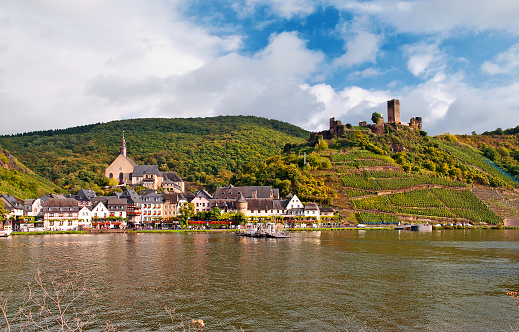
 No better place to begin than geography. Germany's wine regions lie in the southwest part of the country, bordering Switzerland, France, Luxembourg and Belgium. There are more than a dozen designated wine regions, mainly  along the Rhine, Mosel, Saar and Ahr rivers.  The smallest is Ahr, near the Belgium border,  while long and skinny Baden is the largest, stretching east of Heidelberg then south to Freiberg, along the Rhine River.

Beilstein an der Mosel
Castle on the Rhine
 Then there are the grape varieties, most of which are not familiar to American wine drinkers. Except for Riesling. While Americans were going gaga for Chardonnay, German winemakers were quietly, perhaps too quietly, talking up the virtues of Riesling. There was even the suggestion that Riesling was the king of white wines.  

Just a minute, cried Chardonnay lovers!  That's going to far.

Perhaps, but to understand that claim means getting your head around German wine, something that many wine drinkers discovered ain't easy. That's why the German Wine Academy was started. 

A Personal Remembrance of An Irish/German Prank! 

(There are times in life (some would say far too many) when you don't have a clue. Everything appears to be moving ahead normally and you're confidant you know what's in the future. But a friend has been laying the framework for a practical joke that will slowly mess with your mind.

For me, it started when Denis Broderick and I met at the German Wine Academy, an educational effort with the sole purpose of  providing clarity about German wine. Denis hails from Northern Ireland and has a love of wine. He is a gregarious Irishman with a quick wit, and an easy way with people, so naturally we quickly became friends.

Throughout the week, Denis and I muddled along, learning about German wine, in the classroom and on the road visiting various wineries, large and small along the Rheingau and Mosel-Saar-Ruwer. It was an immersive experience that served to expand my interest in all things Riesling.

After graduation, Denis returned to a small town outside Belfast and I went back to California.  It never occurred to me then that my friend Denis was cooking up a delicious joke that didn't begin to unfold until months later.

I had an assignment to write a piece about Scotch whisky and Irish whiskey, so I packed my bags and headed for Scotland and Northern Ireland. Doing a distillery tour through the Scottish Highlands is a pleasant way to experience the beauty of Scotland, eventually ending up along the rugged west coast. (Note: The Scots and Canadians prefer the spelling "whisky," while the Irish and Americans use "whiskey."

To get from Scotland to Northern Ireland, you can fly. A more interesting, low-key way to cross the Irish Sea, is by sea-going ferry. You board in Cairnryan, on the west coast of Scotland and land in Larne, the eastern port north of Belfast. It's not as fast as flying but is far more civilized and relaxing.

An appointment was set for me at Bushmill's, the premier northern Irish whiskey, the following morning, so I checked in to my lodging.  

"Ah, Mr. Boyd, I have a message for you," said the desk clerk with a friendly smile. 

My wife had my itinerary, so it could be from her... maybe something is wrong?  "Welcome to Ireland, Jerry," signed "Your German girlfriend."  What's up with that, I thought?

In the days that followed, there was a message waiting for me, from my mysterious "German girlfriend,"  when I checked in to my lodging. My traveling companions were beginning to eye me with suspicion.

Then on the day before leaving, I was invited to lunch at a very nice country inn. I don't remember the name of the inn, but I distinctly remember the owner's greeting. 

"Jerry, I regret to tell you that the rabbit died!"  Signed by you know who. 

Here I am, standing there dumbfounded in the middle of this lovely Irish inn, feeling like everyone was in on the "German girlfriend" thing but me. So, I tried to act nonchalant, but my brain was spinning. Then a light went on. 

"Do you know Denis Broderick," I asked the inn owner?  He laughed, slapped me on the back and admitted that he was in on the joke. I had forgotten that Denis was in Northern Ireland catering and that I had sent him my itinerary.  

So, is there a take-away or moral to be learned from all this?  Don't mix German wine and Irish whiskey and remember where your friends live.)

But back to Riesling. Here are a few facts about Riesling, Germany's best-known white wine, compared to Chardonnay, the world's most popular white wine: Riesling stands extremely well on its own, with no oak to prop it up; Riesling is more versatile than Chardonnay, made in a wide range of styles, from very dry to very sweet, even sparkling; Riesling tends to be relatively low in alcohol. Riesling pairs with a variety of foods, from seafood to Asian dishes. 
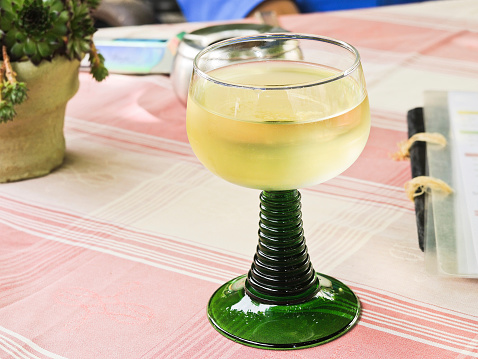
glass of local dry white wine, Moselle region
Riesling in German wine glass

Riesling's charm is its fresh fruit aroma and flavors, balanced with bracing mouth-watering acidity, a combination that makes Riesling an ideal choice with food. And there is a certain floral note in Riesling like jasmine, but often with a hint of honey and minerals.

While the popularity for dry Riesling has been on the rise, Riesling's sweeter side remains under-appreciated. German sweet wines fall into two general classes: eiswein (ice wine) and botrytized wines. To make eiswein, grapes are picked and pressed while frozen. Freezing concentrates the grape sugars and acids. Botrytized wines are made from grapes infected by a good form of bunch rot, known as botrytis, or "noble rot." A botrytized wine, especially Riesling, has a unique honeyed bouquet and flavor. Botrytis is also responsible, on Sauvignon Blanc and Semillion, for the great French sweet wine, Sauternes.

The German Wine Law of 1930, revised in 1971, established a precise set of rules for dry and sweet wines and, in fact, everything from vineyard designations to grape ripeness. Some German winemakers feel that the wine laws are too rigid and strict, not allowing for such things as climate change and the fast moving international wine market. All of this bureaucracy sets standards for the precision and reliability of German wine.
 
There is so much more to know about Riesling and how it all fits in to German grape growing and winemaking. An excellent source I recommend is "The Oxford Companion to Wine." And, here's a short list of German Riesling producers you might look for.  Mosel and Saar: Dr. Loosen, Dr.Thanisch, J. J. Prum, J & H Selbach, Markus Molitor, Monchof Estate, Maximin Grunhau. From the Rheingau: Georg Breuer, Goldatzel, Kunstler, Leitz, Schloss Johannisberg, Schloss Vollrads, Spreitzer Estate. 

                                                                          -O-

Please contact me at boydvino707@gmail.com for my policy on submitting wine samples. Unsolicited samples will be returned to sender.

Next Blog: I'll be on vacation, so the next blog, on Syrah/Shiraz, will be posted on September 17, 2019.


Sunday, August 18, 2019

Adding Oak Seasoning

The history of using wood for barrels and tanks is almost as old as wine itself. From about the 6th century to the 3rd century BCE, clay amphorae were used to store and transport various liquids such as oil and wine. But there was an inherent problem with amphorae: clay is porous and liquid leaks through it. So, the answer was to coat interior surfaces of the amphorae with pine resins.Today's Greek Retsina is the descendant of those early wines.


Yet, as important as wood is to winemaking, wine consumers hardly know of the presence of wood in the wine they are enjoying. 

Wine Cellars, Caves, Tunnel, Parabolic
Barrel Cave
Oaked Chardonnay is a case in point.  Beginning in the late 1970s, California Chardonnay, often with a heavy hit of new toasted French oak, became synonymous with white wine. An order in a fashionable city wine bar of the era for a glass of white wine, meant oaked Chardonnay.  


For hundreds of years, French oak has been the wood of choice for winemakers around the world. But shipping oak barrels from France to far-flung places like Australia, Chile and California was costly, so cost-cutting strategies were employed or locally grown woods were used.  Australian wineries opted to import American oak blanks, then fashion the barrels there. Chileans opted for an evergreen beech called rauli and California winemakers built large tanks from native redwood. For many years, chestnut was widely used in northern Italy.  Now wineries can choose from American, French, Russian and Eastern European oaks.

Winemakers, however, have settled mainly on either French oak or American oak. The planting, cultivating and harvesting of oak trees, mainly in northern France, is closely regulated by the French government. American white oak forests, mostly in the mid-west states of Missouri, Minnesota, Iowa, Ohio and Indiana, are privately owned. 


The use of wood as a seasoning for wine is an integral part of the wine's flavor and texture. Wood, more specifically oak, gives a wine texture, and more importantly, an added dimension of flavor. The trick is to select the type of oak that is most compatible with the wine and to gauge the right amount of time a wine is in contact with the wood.

The grain structure of American oak is tighter and less porous.  Thus, some winemakers   believe that American oak is too strong and sappy, especially for white wines. The feeling is that the more forceful American oak is better suited to big reds like Australian Shiraz (Syrah) and Cabernet Sauvignon grown in warmer climates. The flavor profile of American oak includes: vanillin (vanilla) higher in American oak than, coconut-like notes from lactones, cloves and firmer more assertive tannins 

French oak has an open grain and is more porous. There is a range of French oak types,  although a lot of the barrels are being sold as bois du centre, wood from the center of France. These are the most  common French oak types: Allier, a tight-grain oak from south of Sancere; Limousin, a wide-grain oak more often used for brandy aging than wine; Nevers, a tight-grain oak from forests near Allier; Troncais, a central France oak. Vosges, a tight-grained oak, similar to Allier and Never  French oak is noted for its softer tannins, sweet spices, sometimes with a hint of vanilla.

(How I Almost Raised a Barrel.  It's a snap, a piece of cake, I innocently thought as a burly man handed me a large metal hoop and pointed to an array of oak staves. 


The place was Napa, California and I was a "student" at the impressively named "College of the Oaks," administered by the French cooperage Seguin Moreau . During my years in college, I had struggled with many assignments, but building an oak barrel was a task I never expected to undertake. 

A cooperage is where barrels are made by a cooper. A cooper builds "raises" barrels forn the aging of wine and spirits, although there are other uses for wood barrels such as the maturing of balsamic vinegar. 


Image result for coopering tools
Cooper's tools
Traditionally, the coopers craft was a hands-on manual process that, until the last decade or so, had resisted mechanization. Oak staves were sawed, shaped and assembled, all by hand, to form a water-tight container. Today, machines do a lot of the hard tedious work, like shaping a stave and forcing the metal hoops in place to hold the barrel together.
Still, the inside of a cooperage is hot and loud. I was told by a director of one of the cooperages I visited in France that the coopers union is one of the best in France, assuring members work shorter hours, earn good salaries and retire earlier than members of many other unions in France. 

It was in this hot and noisy atmosphere where I faced my final test in the College of the Oaks.  Earlier, my fellow students and I had attended classes on the craft of coopering and the various types of oak trees and their characteristics that are used for wine barrels. Then, on the cooperage floor, we were asked to put our knowledge to the test. 

Basically, the process of raising a barrel by hand, involves selecting the required number of staves from a rack (including a strong and wide stave for the bung hole), resting one side of a "raising up" iron hoop on a stable surface, holding the other side of the hoop and then arranging the staves around the inside of the hoop.  

Sounds easy, right?  Well, you need a keen trained eye to select the staves that will fit exactly, one beside the other, so that the barrel will be tight and not leak.  All while keeping the other staves upright and holding the metal working hoop up, which is now getting heavier by the minute. 

Assuming you pass all of those steps successfully, with the hoop holding all of the staves upright (which is probably not gonna happen unless you're a nimble Dwayne Johnson), you then grab a wooden wedge and a hammer and work the hoop into its temporary position (?) by walking around the barrel while repeatedly striking the wedge driving the hoop down over the staves. The hammer doesn't feel that heavy when you pick it up, but think of bashing the wedge with the business end of a 12-pound sledge hammer, but with a short handle. 
Wine, Barrel, Wine Barrel, Barrels
Barrels waiting to be filled

Then, you tip the barrel and roll it over a fire fed by oak chips,to toast the interior and shape the barrel. Cables are wrapped around the base of the barrel and you turn a capstan bending the staves into shape. The two heads need to be inserted and the bung hole drilled, but by now, I've turned the barrel raising over to a cooper.


Full disclosure: I had more than a little help from a cooper raising my barrel.)

Toasting a wine barrel requires setting the open end of the barrel over a hot fire, for between five and 15 minutes, depending on the level of toasting: light, medium or heavy.. Toast levels vary by cooper, but in general the vanilla and coffee seasoning begin to show with a medium toasting, while a heavy toast is more roasted coffee, spices and even smoked meats.   

Finally, the heads are fitted into place and the new barrel is tested for leaks by injecting steam or hot water into a small hole drilled in the bung stave.  If the barrel is water-tight, the hole is drilled to bung size and the barrel is ready to be sold. 

                                                                 -O-

Please contact me at boydvino707@gmail.com for my policy on submitting wine samples. Unsolicited samples will be returned to sender. 

Next Blog: Is Riesling the World's Finest White Wine?


Thursday, August 8, 2019

Bordeaux Options


Single variety wines or blends, which one is best?  The question has troubled wine drinkers for years and while most people would agree that it's a matter of personal taste, there is one historic example that may help an undecided wine drinker to come down on one side or the other. 

California winemakers started building a reputation for red wine with 100% varietal wines, such as Cabernet Sauvignon. About 35 years ago (can you believe it!) a shift toward blends began to build steam, and in 1981, the Meritage Association (now Alliance) was formed to distinguish those red blends made from two or more of the Bordeaux grapes from other red blends. There is also a white Meritage.

For more than one hundred years, winemakers in Bordeaux have relied on a blend of up to five grapes to produce a red wine that has become a benchmark around the world. French winemaking is regulated by the Appellation d'Origine Controlee, known commonly as AOC.  One stipulation for Bordeaux AOC is that wines are not identified by a single variety, but as a blend of at least two of the five authorized red grapes. 

The five grapes, in order of planted acreage are: Merlot (the most planted), Cabernet Sauvignon, Cabernet Franc, Petit Verdot. and Malbec. Carmenere, an historic red grape in Bordeaux, is also an accepted red grape, but it is a minor player today.

The decision to  plant which grapes where was based mainly on the terroir and geography of each of the major wine districts. Hugging the left bank of the Gironne esturary is the Medoc, the largest of the major districts  and arguably the most important. Within the Medoc are such noted sub-appellations as St.-Estephe, Pauillac, Saint-Julien and Margaux. South of the Medoc and the city of Bordeaux are Pessac-Leognan and Graves.
  
Terroir is the French term for all of the natural factors, such as soil and topography, that influence a vineyard site.

On the right bank, closer to the Dordogne, are St. Emilion (and its sub appellations such as 

St. Georges-Saint Emilion), Pomerol and Lalande-de-Pomerol. Tempering the sometimes harsh climate of Bordeaux are the Atlantic, the Gironne estuary, the Garonne river that feeds into the Gironne and to the northeast, the Dordogne river. 


Not all five red grapes are planted in all parts of Bordeaux. Cabernet Sauvignon and Merlot are the major red grapes along with a little Petit Verdot, in  the Medoc and Graves.  There is virtually no Malbec left in the Medoc. Merlot and Cabernet Franc predominate in the cooler right bank soils of St. Emilion and Pomerol.  

Over the years Bordeaux winemakers have observed the importance of terroir while showing a personal preference for one grape over the other as factors dictating the blend.  First Growth Pauillac chateau blends are primarily Cabernet Sauvignon, Merlot and Cabernet Franc, in that order. Chateau Mouton Rothschild has the highest amount of Cabernet Sauvignon at 80%,and 16% Merlot. Chateau Latour's blend contains 75% Cebernet Sauvignon and 24% Merlot,  Further south in the Graves district, Chateau Haut-Brion opts for a nearly equal amount of Cabernet Sauvignon (40%) and Merlot (49%). Haut Brion also has the highest amount of Cabernet Franc, 11%.

(Tasting Chateau Latour. I have long admired the elegance and complexity of Ch. Latour, so I jumped at the chance to attend "La Fete du Chateau Latour," an impressive two-day tasting of 89 vintages of Latour, from 1861 to 1979, in 1981 at the Four Seasons Clift Hotel in San Francisco. The marathon tasting was led by Michael Broadbent, M.W., then of Christies Auction House in London.

To say that this was a once-in-a-lifetime experience, is an understatement, for which I was not sure I was up to...but I was anxious to give it a try.

There were two tastings on day one, the first at the civilized hour of 11 am, and the second at 6 pm. The morning tasting consisted of 30 wines, from 1950 to 1979, with standouts (for me): 1955,1961 (a storied 20-year-old Pauillac with depth and richness), 1964, 1966, 1970, 1975 and 1979. 

That evening, another 30 wines were poured, from older vintages 1918 to 1949. I especially liked 1920, 1926 (full fruit, complex), 1928 (sweet fruit), 1934 and 1936 (both nicely knit wines with delicate flavors and great length), Wines from the war years suffered, but Latour bounced back with very impressive wines in 1946 and 1948. 

On the second day, we re-assembled to taste 29 older wines, from 1861 to 1917.  With few exceptions, the wines from 1861 to 1899, were in good but not great shape, with 1865 and 1870 noteworthy for their exceptional balance and firm delicate flavors. 

Perhaps it's a stretch to say that a wine more than 100 years old still shows vitality and length, but it did!  This is a testament to the longevity of Cabernet Sauvignon, the talent of the winemaker and the positive merits of a blended wine.  But it is also a plea not to drink your wines too young.

What impressed me, besides the wines, was Latour's consistency of style, year after year, especially when you consider how many maitre de chais (cellarmaster) were trusted with that style. And, even considering a tweaking of the blend to account for vintage differences, the power of Cabernet Sauvignon came through, supported by Merlot's softening fruit.)

What's the take away?  That can best be answered by looking at what each of the five Bordeaux grapes contribute to a blend.

Cabernet Sauvignon: Black berry, black cherry, tobacco, dried herbs, mint, sometimes  eucalyptus, firm tannins and structure. Unripe cabernet an be green, like green bell pepper.
Merlot: Black fruits like plums, black cherry, black berry, sweet spices like cloves, the impression of softer tannins.  Under ripe Merlot often shows hints of dill.
Cabernet Franc: Perfumed sweet fruits like raspberries, softer tannins than Cabernet Sauvignon. 
Petit Verdot: Floral notes like violets, sweet spices, medium tannins, crisp acidity.
Malbec: Ripe rich fruit flavors, plums, floral notes, full tannins, good structure and length.

With blends, the sum is more pleasureable than the individual components, but if the characteristics of one of the five Bordeaux grapes strikes your fancy, then go with the single variety wine.
 
Please contact me at boydvino707@gmail.com for my policy on submitting wine samples. Unsolicited samples will be returned to sender.

Next Blog: Making Wine with Wood