Friday, January 24, 2020

Wine and the Written Word

The popularity of wine in the United States is likely due to the boundless curiosity of the American consumer. When Americans find something to like, something new they think will make their life better and more interesting, there are no limits to their curiosity. 

About fifty years ago, give or take a few years, the American drinking public began to nurture a curiosity about wine. The exact date is not clear, but probably the late 1960s, early 1970s. Of course, Americans had been drinking wine before that time, but it was mostly local wine made from native grapes and inexpensive French and Italian wine that sold in large cities in the northeast and a few cosmopolitan places along the west coast. And there was a select interest in more upscale French wine, developed by returning American servicemen who had served in the European theater in World War II.
                                   Image result for free writing line art

Curiosity about wine began to grow as folks discovered the writings of a small group of English wine writers (Andre Simon, Harry Waugh, Edmond Penning Rowsell, Wyndham Fletcher, Michael Broadbent, Pamela Vandyke Price) who had set the standards for the nature of wine writing in the English language. More contemporary influential writers, who are still actively writing about wine, include Hugh Johnson and Jancis Robinson.

By the 1960s, the British had developed a taste for French and German wines. However, Americans had yet to develop their taste for these wines and even less for Spanish and Italian wines. In those days, the French were more parochial, believing that if the wine in the glass wasn't French then it likely wasn't wine. Such a parochial attitude didn't help Americans learn more about French wine. 

But then, along came a young English wine merchant who taught the French and the world of wine, a humbling lesson. In the early 1970s, Steven Spurrier decided to teach the Parisians about wine by opening a wine shop and wine school in Paris. Gutsy or arrogant, Spurrier went even further by pitting California wine against French wine in a 1976 tasting that would become known as the "Judgement of Paris." And he chose nine French wine professionals as judges. The results, much to the surprise and dismay of the judges, was that a California Chardonnay bested a white Burgundy and a California Cabernet Sauvignon won over a top Bordeaux chateau red.


Spurrier's surprise was a shot that reverberated through the nascent U.S. wine writing community, bringing new writers into the craft of wine writing. A joke then held that all you had to do to be a wine writer was convince an editor you were one. The uptick interest in wine also encouraged active wine writers, including myself, to get busy. 

I was in Colorado then writing a wine column for the Rocky Mountain News and contributing wine articles to the Denver magazine. Wine columns were a new thing in specialty writing. All major airlines had a wine article in their in-flight magazine, city magazines weren't complete without a wine column and every metropolitan newspaper with a food section had a wine column. Still, there was only a dozen or so active American wine writers.


Robert Misch was in New York along with Roy Andres DeGroot, a Belgian emigre who wrote a wine column then for Esquire magazine. Ruth Ellen Church, possibly America's first woman wine writer, was informing Chicagoans about wine through her column in the Chicago Tribune. Later, Church was joined by other woman wine writers like Barbara Ensrud, Eunice Fried, Mary Ewing-Mulligan in New York, Marguerite Thomas in Baltimore, Jane Moulton in Cleveland and Linda Murphy in California.

Early west coast wine writers included Hank Rubin at the San Francisco Chronicle and Robert Finigan with Walnuts and Wine, perhaps one of the first successful wine newsletters. Also Robert Lawrence Balzer had a popular wine column in the Los Angeles Times. 

Image result for free computer line artThere were, of course, lots of professional journalists with an interest in wine. Frank Prial, the New York Times Paris Bureau Chief for years, went on to become the Times' best-known wine columnist, eventually to be replaced by Eric Azimov. Nate Chroman, an attorney, shared wine writing with Balzer at the L.A. Times, Bob Thompson, a generalist writer, signed on as the wine writer for the San Francisco Examiner and sports writer Dan Berger build a wine writing resume with columns for the San Diego Union, LA Times and Santa Rosa Press Democrat. Burton Anderson, an American living in Italy, established his credentials as an Italian wine expert with the seminal book Vino.

Interest in wine writing was spreading fast across the country. Wine columns caught on in Texas, with Dallas writers Rebecca Murphy (now Seattle) and Diane Teitelbaum and Michael Lonsford in Houston. Others included Dee Stone and Richard P. McKensie in Atlanta, Steve Taylor in New Orleans and Tom Stockley in Seattle. There was hardly a major U.S. city then without a wine writer or two.  

Parks Redwine
(Wine Writing Trivia: Richard P. McKensie may be the only pen name in American wine writing. The man behind the name, Hill Parks Redwine II, was a member of a family that owned a bank in a conservative part of Atlanta. He was told that if he wrote a wine column under his own name, many clients who were against the use of alcohol in any form, would take their business elsewhere. Thus the appearance of Richard P. McKensie, wine columnist for the Atlanta Journal-Constitution. Parks Redwine died in 2018.)

More writers got into the game including Robert Whitley, Rod Smith, Michael Franz, Paul Lukacs, Ed MCarthy, Larry Walker and Paul Gregutt. And this partial list doesn't include writers who cover the wine trade.

At the same time wine magazines began to flourish. In the early 1970s a group of English Masters of Wine founded Wine magazine, which eventually morphed in 1975 into Decanter magazine. In Chicago, Grand Cru published a few issues and then folded. The Wine Spectator began as a tabloid newspaper in La Jolla, California in the mid-1970s, then, after changing to a magazine format, became the most widely circulated wine magazine in the world. And in 1977, Quarterly Review of Wine (QRW) began publishing in Massachusetts and in 1986, Italy's Gambero Rosso was founded. In 1982, the Australian-owned Wine & Spirits Buying Guide began publishing in California, later changed to American ownership and became Wine & Spirits magazine. Wine Enthusiast, 1988, also began small but since has become a major U.S. wine magazine. 

Today, in-flight wine columns have disappeared, the number of newspapers with wine writers has dropped way off and wine writing in general is going the way of pop wines.  Like so many other things, wine writing in print is giving way to electronic media, like the wine blog you have just read.  

Cheers!

Next Blog:What's Up with Viognier?

Comments?  Suggestions?  Email me at boydvino707@gmail.com

Tuesday, January 14, 2020

"Cabernet without the pain"


By now, anyone with even a casual interest in wine has heard the snarky line about Merlot uttered in the 2004 movie "Sideways." When offered a glass of Merlot instead of his favored Pinot Noir, Miles snarled "I'm not drinking any f!*#ing Merlot!"                                                                                                                                  

It was a simple throw-away line, but for some reason, Mile's criticism of Merlot resonated, creating ripples in the California wine industry. The degree of the impact is debatable, but no one could have predicted the sales backlash. Sales of Merlot dropped, at least temporarily, while Pinot Noir sales got a big boost. 

How important was the "Sideways" hullabaloo? Not very, I'd say. After all, it wasn't like Miles was a serious wine guy. He came off as a smug self-important wine drinker on a weekend jaunt, hoping to get lucky and drink some Pinot Noir. 

Maybe the question is does Miles, and by extension some wine consumers, understand Merlot?  At some point during the post-"Sideways" flap, someone said that Merlot is "Cabernet without pain," implying that Merlot has lower and softer tannins than Cabernet. Merlot does give the impression of being softer than Cabernet, but Merlot has more texture and up-front fruit, especially when both wines are young.

So what has happened with Merlot since the movie was released? Well, the California Merlot grape crush has mostly seesawed from one year to the next. The latest numbers I could find are from 2016, showing the total tons of California Merlot crushed in 2005 jumped to 425,000 from 300,000 in 2004. Then, starting in 2006, crush numbers settled down to approximately 325,000 tons until 2014, when the total dropped below 300,000 tons. As of 2016, Merlot was holding a 7% share of the total varietal market.   

Before Merlot stepped on to the world stage, it was valued as the primary grape of St. Emilion and Pomerol, two of the best red wines of Bordeaux. Merlot and Cabernet Franc are the main grapes in St. Emilion and Pomerol. Merlot is also a component part of the great red wines of the Medoc, although it is secondary there to Cabernet Sauvignon.  


(And that reminds me...In the late 1970s, when I was editor of the "Wine Spectator," I got a letter (pre-email days) from Alan Spencer, an Englishman living in Castillon with his French wife Monette, not far from the historic city of St. Emilion.

While traveling for his French computer software company, with the amusing name of "Kalamazo," Alan saw a copy of the "Wine Spectator" in an airport waiting area. 

Being an avid wine drinker, living in a world-famous French wine region, Alan bought a copy of the Spectator and began reading it on the plane. Months later, after we
became friends, he told me that he noticed there was no "correspondent" writing about Bordeaux. "So, I wrote you a letter saying that I had some wine contacts in the region and could send you news and reports on the local wines."  

Even later, on a trip to Bordeaux, Alan told me that he and Monette had become friends with Pascal Delbec, then the manager and winemaker of Chateau Ausone, one of St. Emilion's premier wineries and would I like to meet him and visit the chateau. 

Pascal Delbec is a quiet unassuming man who listens intently to questions and comments then considers his answers carefully before answering. Long story short, my visit to Ausone and conversations then and later with Pascal, introduced me to Merlot and demonstrated how as a single varietal, or even with the addition of a little Cabernet Franc, it shares greatness with the Cabernet Sauvignons of the Medoc.

The Merlot I tasted at Ch. Ausone and at other chateaux in St. Emilion and Pomerol had an earthy, slightly herbal character, just under layers of fruit. I had tasted a number of California Merlots, finding them stylistically split between fruit-forward almost plumy to slightly herbaceous, bumping up against dill in some cases. As the popularity of Merlot grew, that herbal characteristic disappeared from most California Merlot.)

Image result for free Merlot grape photos
Merlot cluster
Herbaceousness in wine is usually due to cool growing conditions, often resulting in under  ripe grapes. Merlot, an early-maturing variety, does well in cool soils and moderate temperatures, the sort of growing conditions to be found in eastern Washington, more than the warmer areas of California. 

Washington Merlot is well structured and fruity, but lacks the lush plump flavors of its California cousin, a style closer to St. Emilion than Sonoma and one that has a growing number of admirers. Here are four Washington Merlot producers worth a try: Long Shadows, Leonetti, L'Ecole No. 41, Seven Hills. 

California Merlot languished in the backwater of the state's vineyards until about 1970 when a handful of Napa wineries, notably Louis Martini and Duckhorn Vineyards, looked for a grape to soften the harsher tannins of Cabernet Sauvignon, bringing Merlot out of retirement. 

Today's California Merlot emphasizes black fruits, like dark cherries and plums, occasionally with an earthy or herbaceous note. California Merlot worth a try include Whitehall Lane, Duckhorn, Pride Mountain, La Jota, Ch. St. Jean, Markham, Trefethen, Keenan.

Although St. Emilion and Pomerol remain as the benchmarks for Merlot, they are priced well above many wine budgets. Look for better deals from California and Washington state. And forget Miles' dismissive rant; enjoy Merlot. 

                                                                -O-

Next Blog: Wine and the written word. 

Comments? Suggestions? Email me at boydvino707@gmail.com


Saturday, January 4, 2020

Italian Wine Tour

When I think of Italy, I'm reminded of how full of wine it is. From the top of the boot to the toe, wine is produced in all 20 regions, including Sicily and Sardinia. In fact, Italy produces more wine than Spain, France, United States and China. 

And in case you are still not impressed, here are more gee-whiz facts. Wine was introduced to the Italian peninsula by Greek colonists. By the 2nd century B.C.E., wine began to flourish throughout the country. Italy accounts for an impressive 19 percent of the total world production. 

There are 350 grapes authorized for the production of wine. When most people think of Italian wine, though, red wine gets the nod more often than white wine. Yet, of the hundreds of authorized wine grapes, there are 17 white and 12 red grapes that are the most common and important. 

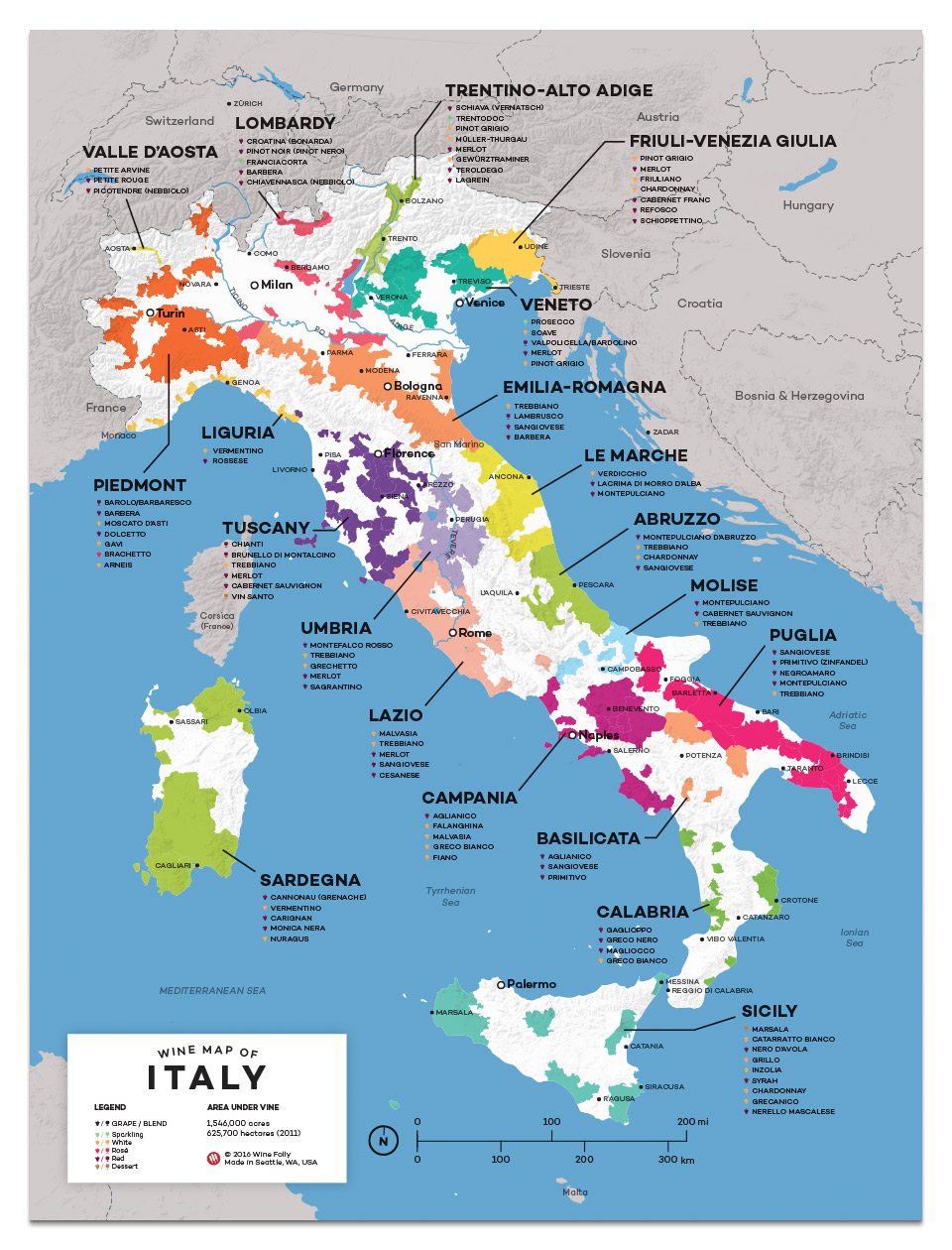
For a closer look at the presence today of wine in Italy, here's a brief look at key wines, through a region-by-region wine tour, starting in the northwest and zig-zagging south through the country, to the island regions of Sardinia and Sicily.

Italian Wine Map by Wine Folly
Italy 's 20 wine regions

Valle d'Aosta: Italy's smallest wine region, stands at the foot of the Alps, bordering France and Switzerland. Emphasis here is on Nebbiolo, Dolcetto and Pinot Grigio, but indigenous grapes like Petit Rouge are seeing a revival.
Piedmont, one of Italy's most important wine regions. The Piedmontese stars are Barolo, Barbaresco, Dolcetto, Barbera and Asti Spumante. Piemonte is the world-famous home of the Nebbiolo grape and boasts a dozen Nebbiolo-based DOC and DOCG wines. 

The Italian wine classification system, enacted in to law in 1966, is known commonly as "DOC." Denominazione di origine controllata (DOC) applies to hundreds of wines throughout the country. DOCG (the "G" for guaranteed) is for a small number of select wines of "particular esteem." DOC also includes Vini da tavola and Vini tipici wines.

Manarola, Italy
Manarola, Cinqueterre
Liguria, the third smallest wine-producing region is known for its near-vertical vineyards, reaching to the Mediterranean and the famous villages of Cinqueterre. The best known white wine is Cinqueterre, made from Vermentino. Reds include Dolcetto.
Lombardy, a large region that includes sparkling Franciacorta, Lugana (dry white) and the ubiquitous Lambrusco, a popular wine it shares with Emilia-Romagna. Lombardy has 22 DOCs, five DOCGs and...the city of Milan.
Trentino-Alto Adige, an alpine region along the Adige River, noted for Chardonnay, Pinot Grigio, sparkling wine and the red Lagrein, all in Trentino. Alto-Adige is better known for international varieties such as Pinot Noir, and the local red variety Schiava.
Veneto, a productive region best known for Soave, Amarone, Bardolino, Valpolicella and the wildly successful Prosecco, of which the wines of the twin villages of Coneglino-Valdobbiadene have attained DOCG status.
Friuli-Venezia-Giulia, a northern region bordering Austria and Slovenia, is noted for the white Tocai Friulano and red Refosco, as well as a string of varietals made from international grapes like Merlot and Sauvignon (Blanc).
Emilia-Romagna stretches across north-central Italy and is known primarily for Lambrusco in all its many styles. Pinot Noir and Cabernet blends are also popular.

Image result for free Tuscany wine photos
Castles of Tuscany
                                                                                                        

Tuscany, the most important region in central Italy, counts Sangiovese as its main grape. Brunello di Montalcino, Bolgheri (reds), Chianti Classico and Vino Nobile di Montepulciano are Tuscany's world class red wines. Tuscany boasts 48 DOCs and DOCGs.
Umbria, a landlocked region, Umbriia shares a lot of similarities with neighboring Tuscany. Orvieto is Umbria's most noted (white) wine, with the red Sagrantino gaining interest.
Marche, an east-central region with coastal and mountainous vineyards is best known for the white Verdicchio. Sangiovese is the most widely grown red.
Abruzzo is south of Marche on the Adriatic sea. The best red is Montepulciano d'Abruzzo and top white, Trebbiano d'Abruzzo.
Latium is the site of Rome, Italy's capital, as well as the Castelli Romani wines. Frascati and the modest Est! Est!! Est!!! are the best known white wines. 

Local Lore: Bishop Fugger, a German cleric traveling through Italy, supposedly sent his servant Martin ahead to find an inn serving good wine. When Martin got to Montefiascone, in Latium, he found a white wine he liked so much that he excitedly marked Est! Est!! Est!!! (Here! Here!!  Here!!!) on the inn door.

Molise is Italy's second smallest region. Very little wine is produced in this mountainous area of southern Italy, with the two most prominent being Montepulciano d'Abruzzo and Trebbiano d'Abbruzzo.
Campania is home to the wines of antiquity, championed by a group of wineries, Mastroberardino the most prominent. The region is noted for native wines such as Falanghina and Lacryma Christi. Campania boasts three DOCGs: Taurasi, Greco and Fiano.

More Local Lore: Lacryma Christi ("tears of Christ") is a wine from the volcanic soils of Mt. Vesuvius. There are many fanciful versions of how the wine got its name, but the best known says that when God cast Lucifer from heaven, the fallen saint fell to earth forming the Bay of Naples. Grape vines miraculously sprouted on Vesuvius where God's tears fell. 

Puglia, on the heel of Italy, is known for wine and table grapes. It is the second most productive wine region behind Sicily. Sangiovese is the most planted variety, with Primitivo a leading local grape.
Basilicata is a land-locked region in southern Italy with only four DOC wines and one DOCG, Aglianico del Vulture. Also popular are international varieties such as Cabernet Sauvignon. Aglianico is the red grape--Vulture is named for the volcano Mount Vulture.
Calabria, the toe of the boot of Italy, is a rugged region, just a short distance from Sicily with wines more of local interest. The DOC wine Ciro is the most important.
Sicily, one of Italy's most dynamic wine regions was settled by Greek colonists in the 8th century B.C.E. Sicily has a thriving wine culture, with a mix of international and local grapes. Popular wines include whites from Cataratto and the red Nero d'Avola.
Sardinia is an island region about 125 miles off the coast of mainland Italy. Spanish Catalans were among the early settlers and today the Spanish grapes Garnacha (Cannonau) and Carignan (Carignano) are the most important Sardinian varieties. 

What is evident from this brief look at the wide range of Italian wine is there is a wine for every taste, from the light and crisp whites of Trentino to the world-class reds of Piedmont and Tuscany, to the modern versions of ancient grapes like Fiano di Avellino and Greco di Tufo.

Image result for free Italian food photos
Traditional foods of Basilicata
                        
There are as many food choices that marry well with Italian wines as there are Italian wine choices. Just as versatile are the many styles of cuisine. In general, the northern regions feature more rice than pasta, while further south, pasta is more commonly seen gracing the Italian table. Southern regions, Sicily and Sardinia concentrate on seafood and shellfish dishes, while poultry and meat are more often seen further to the north. These, however, are only generalities. No region in Italy is that far from the sea, the wheat fields of the central and southern plains and the rice patties of the north.

Although you will find Italian wines made from international varieties such as Cabernet Sauvignon and Chardonnay, the true flavor of Italian wine is best experienced from the many local or indigenous grapes such as Sangiovese, Aglianco, Nebbiolo, Trebbiano and Cortese.

Exploring Italian wine can be a life-long journey. Start anywhere in the country, then proceed as the Italians do, leisurely and with gusto.  Salute! 


Next Blog: Merlot Essentials

Comments? Suggestions? Email me at boydvino707@gmail.com

Wednesday, December 25, 2019

The Pleasures of Port

More things happen by accident than we know. Supposedly cheese was discovered when a Roman Legionnaire filled a sack, made from an animal's stomach, with goat's milk and placed it between his leg and the horse's body. During a vigorous ride, the contact heat curdled the milk, helped along by the rennet inside the skin, and fresh cheese was born. 

Port History
True or not, it's a nice story. A more political scenario evolved with the discovery of the fortified Portuguese wine we know today as Port. 

(I pause here, during this holiday season, remembering (vaguely) a time in my boyhood when my mother would take a little port. Mom was an enthusiastic practitioner of folk medicine,
Dining in Portugal
believing, for instance, that port was an elixir that would "build the blood."


Mom and I lived in a small one bedroom unit in the back of a converted tavern. Clara Ellis, her World War II amputee husband, Howard and their young daughter, Corinne, lived in the front unit. We didn't have a car so Mrs. Ellis would occasionally run errands for my mother in her torpedo-back Pontiac. 

One day, Mrs. Ellis stopped by to tell my mother that she was going to the state store and did my mother want anything for the holidays. Mom gave her the money for a bottle of port. 

In the 1940s, the only way to buy a bottle of wine, spirits or beer, in fact anything with alcohol, in Pennsylvania, was to go to a state store. Licensed restaurants also served alcohol, or you could drive across the Delaware River to New Jersey where alcohol sales were more relaxed.

I was outside playing when the Pontiac returned, easing up to the curb in front of the house. On the way back from the state store, Mrs. Ellis must have stopped by the tavern to get here husband, because I saw them arguing about something. The disagreement didn't last long when Mrs. Ellis got out of the car, and leaning over to look across the front seat, snarled: "Well, Howard, you can just stay there!"


And he did, for a while. But eventually, with some effort, Mr. Ellis lifted himself out of the passenger side of the car, struggling to maintain his balance, while holding onto the car with one hand and his artificial leg with the other. 

Then he looked across the street and seeing our nosy neighbor peeking out her window, Howard Ellis waved his artificial leg in the air and yelled, "That's right, you old bat, I'm drunk again!" Howard Ellis never got over the loss of his leg in the war and how that trauma kept him from being the man he wanted to be after the war.

As I stood there watching  this little drama that I didn't really understand, Clara Ellis  came out of the house and helped her husband inside and then brought the bottle of port around, likely from a Finger Lakes winery, for mom, who nursed it through Christmas and New Year.)


But I digress...In the early 1690s, the scenario in Portugal involved a trade war between the French and English. Seems the English were enjoying their French wine until a disagreement occurred prompting harsh tariffs to be imposed, driving English wine merchants to look elsewhere for wine. That place was northern Portugal. 

Image result for free port wine photos
Terraced vines in the Douro River valley
                                               
                        
What was available to the merchants was a thin acid white wine (probably Vinho Verde), which the merchants quickly rejected. Instead, they went inland along the Douro River and found a deeply colored, big and lusty red wine. The trick was to get the wine to London in good condition, so the crafty merchants added a little brandy to stabilize the wine for the sea journey. 

Similar scenarios apply to the almost instant popularity of three fortified wines from the Iberian Peninsula: Spanish Sherry and Portuguese Madeira and Port. And it was all because the English and French did not like each other very much.

The evolution of port as we know it today didn't happen overnight. One version of the change holds that the English wine merchants discovered the way to make port when a merchant found monks in a mountain monastery adding brandy during fermentation, killing off active yeasts and producing a sweet red wine. Most of the changes that came after, between the 17th and 19th century, were economical and political. But then the port business took a severe hit when phylloxera (a small root-feeding aphid) swept through the Douro. 

By the 1980s, the port industry slowly clawed its way back with new innovations such as reducing vine density, planting new vineyards on vertical rows rather than horizontal terraces with costly retaining walls.  

Port Varieties & Winemaking
Since the 1970s, most port wine has been made from just five grapes -- Touriga Nacional, Touriga Franca, Tinta Barroca, Tinto Cao and Tinta Roriz. Touriga Franca was formerly known as Touriga Francesa and Tinta Roriz is the same as Spain's Tempranilllo.  Following extensive research and experimenting in the vineyards by the port houses of Cockburn and Ramos Pinto, a selection of 80 authorized grapes was narrowed down to five. Some growers also prefer traditional varieties like Sousao and Tinta Amarela.  


In the process of making red wine, the extraction of color and tannin happens over an extended period. Not so with port, where the aim is to get as much color and tannin as possible before adding grape spirit, stopping the fermentation. 

Traditionally, grapes for port wine were crushed by foot in low granite troughs or lagares. Pairs of men, thigh-high in grape skins, seeds and juice, would trod the mass for up to three hours. The combination of increasing heat caused by the trodding and body warmth, starts a fermentation. Eventually the juice is run off the lagar into a vat partly filled with grape spirit, killing the yeasts, stopping fermentation. 

Today, stone lagares have mostly been replaced by automation. Faced with a shortage of labor and the fact that many quintas, a farm or wine estate, in the Douro valley did not have electricity, port producers turned to autovinification tanks which do not require power. As the fermentation begins in the tank, carbon dioxide causes pressure to build up, forcing an automatic pump over, extracting color and tannins. 

Some port producers still use the lagar for the processing of premium ports, while others employ automated treading machines known as "robotic lagares." These automated innovations,however, are too expensive for the production of large volumes of port.

Port Styles
The style of a port wine is determined by two broad categories. Ruby is the most common and least expensive. Aged in wood, and sometimes cement, for up to three years, a ruby port is filtered and then bottled. A premium ruby carries the designation Reserve.

Tawny is a port aged for much longer than a ruby, changing the color from ruby red to an amber brown. An Aged Tawny has been in wood for six years or more. Tawnies with age indications of 10, 20, 30 or 40 years are approximations since tawny ports are blends. 

Colheita ports are tawnies from a single year, with the date of harvest on the label. Colheitas are aged in wood for seven years or longer. 

Vintage Port represents about 1% of the total port production, is the most expensive, yet is the most popular of all the styles. Vintage port, from a declared vintage, is aged for up to three years in wood and is then bottled. The consumer ages the wine further in bottle, sometimes for up to 40 years if the wine is from a declared vintage. Single-Quinta Vintage is usually from a undeclared vintage and bottled unfiltered.

Other port styles: Garrafeira, meaning "private cellar," a term more often associated with Portuguese table wines; Late Bottled Vintage, a port from a single vintage, bottled between the fourth and sixth years after harvest; Crusted Port, a wine bottled unfiltered so that it throws sediment requiring decanting.

At the western end of the Douro river, are the cities of Porto and Vila nova de Gaia where port houses have their aging lodges. Today, port authorities use the term "Porto" on port labels, both as a reference to the city and to identify the wine as the authentic product of Portugal. 

Porto, Portugal, City, Tiles, Building
Porto river walk on the Douro
                               
Port and Food
There are traditional foods such as walnuts and Stilton cheese that marry nicely with port, but in general port is a fortified wine enjoyed by itself with savory bites or after a meal. As with sweet dessert wines, the rule to remember is balance the sweetness between the food and the wine. 


Port is one of the world's great wines an deserves to be a part of everyone's collection and on everyone's table.

Next Blog: Gerald D Boyd On Wine will kick off 2020 with an Italian Wine Tour.

Happy New Year!

Questions? Comments: Email me at boydvino707@gmail.com.

Sunday, December 15, 2019

Holiday Bubbly


For almost as long as I can remember, the good folks that represent (French) Champagne have worked diligently to persuade sparkling wine makers from throughout the world to stop misusing the word Champagne.  At times, their efforts must have seemed futile.    
                              
Open Champagne Bottle Near Two Cocktail Glasses As a prelude to the holiday season, then, as well as an homage to one of the world's great wines, here are some tips on enjoying Champagne during the holidays and throughout the year. 

All references here to wine with bubbles produced in a delimited area in northern France, will be called Champagne. All other wine with bubbles will be known simply as sparkling wine. I make that distinction because there are still wineries in California and South America that abuse the name Champagne. 

For some unexplained reason, the Champagne houses that make sparkling wine in California label their product sparkling wine, while those same Champagne houses that make sparkling wine in South America use Champana, the Spanish word for Champagne. 

The governmental body that looks after such things is the Comite Interprofessionnel du Vin de Champagne (CIVC). The CIVC also gets a little annoyed with people who insist that Champagne is just a celebratory wine not to be enjoyed at other times. Although the focus of this blog about Champagne is mainly for holiday sipping and dining, I urge you to enjoy Champagne any time of the year. 

The Region and Grapes
The region of Champagne is a short car ride north east of Paris, in the Valley of the Marne river. The relatively small region, shaped like a mushroom, is composed of just over 85,000 acres of vines mainly in the Montagne de Rheims and the Cote de Blancs, along with three other districts. Epernay and Rheims are the main cities, with the smaller, but important town of Ay, not far from Epernay.

Pinot Noir, Chardonnay and Pinot Meunier are the three grapes used in making Champagne. Although all three varieties are grown in each of five districts, the bulk of the best Pinot Noir is planted in the Montagne de Reims, Chardonnay mainly in the Cote de Blancs and Meunier in the Vallee de la Marne.  

While the importance of Pinot Noir and Chardonnay cannot be over stated, creating a blend of the two, sometimes with a small amount of Meunier, allows for the seamless consistency of a house style. 

Making Champagne 
The method by which a wine gets its bubbles through a second fermentation in the bottle is called methode champenoise. The process is long and labor intensive, some estimates claim more than 300 steps, from fermentation to finishing the bottle with a protective hood. 


The first fermentation of a non-vintage cuvee (blend) produces a dry, high acid, relatively neutral base wine. High acidity is necessary to keep the wine fresh throughout the long process. Varietal character is not desirable during the first fermentation since the aim is for character and quality to develop during the process. Next is the balancing of the characteristics of the different base wines in a blending process known as assemblage. Assemblage may also include reserve wines from previous vintages. 


(Blending with Richard Geoffroy. On a visit to Moet et Chandon in the mid-1990s, I was given the opportunity to formulate an assemblage with Richard Geoffroy, then the
winemaker for Cuvee Dom Perignon, Moet's prestige Champagne. Geoffroy had a reputation as a brilliant winemaker, so I was thinking to myself that he may have felt obligated to be patient with the American wine writer.

Not to worry. Richard Geoffroy was a friendly, patient teacher as well as a master blender. I had participated in component blending sessions in Cognac and Scotland and was impressed at the blender's skill and knowledge, faced with dozens of samples, and then to quickly smell and sometimes taste each sample, deciding "yes" or "no," whether or not, to add that sample to the final blend. Champagne blenders may taste up to 70 different base wines before making a final decision on the blend.

We were faced with an array of Pinot Noir, Chardonnay and Pinot Meunier base wines from various vineyards owned by Moet or from contract growers. The Champagne blender must know the different soils and micro-climates of each vineyard and the influences each have over the different varieties. And the blender must evaluate base wines that are out of balance and will only attain balance following the second fermentation.

As we tasted through the samples, Geoffroy asked for my impressions and then he would comment on each wine. Knowing that youthful Chardonnay is citrusy and acidic, Pinot Noir has more body and finesse and Meunier offers a floral note, helped me, but more often than not, I miss-identified the varieties, especially the difference between Pinot Noir and Meunier.

It was a humbling experience and I came away from it with aching teeth from the high acid base wines and a new appreciation for blenders who unerringly practice their skill and art so that we can enjoy our favorite fizz vintage after vintage.)

The second fermentation is where the wine begins to develop style and quality. Liqueur de tirage, a mixture of still wine, sugar and yeasts are added here. The amount of sugar determines the amount of bubbles: light sparkle (petillant), medium fizz (cremant),
mousseux. Today mousseux is used mainly for other French sparkling wines. In all there are seven sweetness levels, with these four the most commonly seen: Brut Nature, 0 to 0.2%; Brut, 0 to 1.5%; Sec, 1.7 to 3.5%; Doux, 5% plus. 

The wines are then bottled and sealed with a crown cap (like the ones you see on soda bottles) and placed in cellars for aging. Champage aging cellars, known as crayeres hold millions of bottles at various stages of aging.

Depending on the producer, the second fermentation can take up to three months or longer. During this period sediment settles on the inside of the bottle, requiring a riddling (remuage) to shake it loose. Today, remuage is done by placing a large number of bottles in a gyropalette (a sort of mechanical riddler) or by the traditional method of mounting the bottles neck down in a pupitre, an a-frame device with holes for the bottles. Manually turning the bottles in a pupitre takes about eight weeks to complete, while riddling in a gyropalette takes just eight days.

Finally, the bottles are placed neck down in a bath of very cold brine, freezing the sediment that has gathered inside the crown cap in to a solid plug. The crown cap is popped off, the sediment plug dislodged (degorgement), sweetness level adjusted, a cork  pressed in place, topped by a metal cap and the whole thing secured by a wire muzzle, then the package is finished with a hood.

The result of this long process is a bottle of non-vintage Brut Champagne, the most popular style. Also available are Vintage Brut, Brut Rose and a prestige bottling, such as Roederer Cristal and Moet et Chandon Dom Perignon. Prices for non-vintage Brut range from $35 to $70. Prestige Champagne prices: Moet Dom Perignon and Krug, $170, Roederer Cristal, $270. 

By comparison, California's Scramsberg Reserve Brut sells for $120, J Vineyards Brut, $23 and Domaine Chandon California Brut, $24.

Champagne and Holiday Food 
Holiday meals are often a mix of something sweet, something spicy and something vinegary, and that makes finding a Champagne that won't fight with at least one of those dishes a challenge. 

With the exception of Brut Nature which is usually bone dry, all levels of Champagne have some sweetness. The equalizing thing with Champagne is the brisk acidity and the bubbles. This sweet/salty/spritzy combination makes salty foods or snacks like smoked salmon, nuts, potato chips and popcorn good choices as appetizers or starter course. 

Caviar and Champagne is a marriage that appeals to some, while others suggest that caviar goes better with Chablis or a lightly oaked Chardonnay. The same suggestion holds true for clams and oysters.

The natural acidity of Champagne is a good foil for creamy dishes and those with high fat content. Turkey and Virginia ham work, but not cranberry sauce and candied yams. 

Desserts of all kinds are favorites during the holidays and if you fancy a Champagne with your pie or cookie, remember the balanced sweetness rule - the sweetness of one shouldn't overpower the other. 

There is so much more to say about Champagne, but I'll close with this ode to Champagne from Madame Lilly Bollinger:

                     I drink it when I am happy, and when I am sad.
                          Sometimes I drink when I am alone. 
                        When I have company, I consider it obligatory.
              I trifle with it if I am not hungry, and drink it when I am. 
                       Otherwise I never touch it -- unless I am thirsty. 

                                    Image result for champagne line art
                                              A voltre sante!
 

Next Blog: The Pleasures of Port

Comments? Suggestions? Email me at boydvino707@gmail.com