Saturday, January 30, 2021

Loire Valley: A Collection of Chenins

"Your stomach is your wine cellar, keep the stock small and cool." Charles Tovey, British wine and spirits writer.


When wine lovers plan a trip to France, Bordeaux and Burgundy are usually at the top of their must-see list.  In the rush to go where everyone else goes, these wine trippers miss one of France's great treasures. 

Along the verdant Loire Valley, you'll find diversity in wine and sights, like no where else in France.  From Saint-Nazaire, where the Loire river meets the Atlantic Ocean, east for 625 miles to the wine towns of Sancerre and Pouilly sur Loire, the valley offers plenty of opportunities to sample wine.

Castle, Chambord, Loire Valley
 Chateau de Chambord

Known as the "Garden of France," for its abundant orchards and vineyards, the Loire Valley is also famous for its many castles, like the massive Chateau de Chambord with its 426 rooms and Chateau de Chenonceau, a 16th century castle with an impressive moat.

Although it is uncertain when the first wine was made in the Loire Valley, records do show that viticulture was well established by the 5th century. Today, the Loire produces the third biggest volume of wine in France, after Bordeaux and the Rhone Valley. 

The Loire is known for its great diversity of still and sparkling wines, with Chenin Blanc and Sauvignon Blanc, the leading varieties.  The array of grapes also includes Cabernet Franc, Cabernet Sauvignon, Pinot Meunier, Pinot Noir, Chardonnay, Pinot Gris and Malbec. 

Wine making in the Loire mostly follows the same techniques employed elsewhere in France, with two notable exceptions: a minimum use of malolactic conversion and mostly no oak contact.

Aside -- The malolactic process converts stronger sharper malic acid (think Granny Smith apples) into softer lower acidity lactic acid (as in dairy products). The goal of a malolactic conversion is to lower the wine's total acidity, help to stabilize the wine and improve its aroma and flavor.  The process is often referred to as malolactic fermentaion, although it is not a true fermentation, but a conversion of one type of acidity to another.  

Although the use of oak is not fashionable in the Loire, a few Loire wineries employ barrel fermentation for both red and white wine. More common is pump over (the movement of red wine from the bottom of a fermenter to the top, to help keep the cap moist while extracting coloring and tannins from the skins in the cap). 

Chaptalization, a winemaking technique named for Jean Antoine Chaptal, its French developer, whereby the wine's alcohol strength is increased by the addition of sugar or grape juice before or during fermentation is even more common.  Chaptalization is used in northern Europe where grape sugars may be low at harvest, however with climate change, the practice is becoming less common.

In recent years, the popularity of Loire wines on Sancerre, Muscadet and Vouvray. Other Loire wines, and there are quite a few, are not that well known outside France.  With that in mind, here is the first of a two-part overview of Loire wines.  Heading up river:

Muscadet --  The Muscadet region is southeast of Nantes, near the mouth of the Loire river.  Muscadet is made from the somewhat neutral Melon de Bougogne. Because of its neutral character, Muscadet is often left on its gross lees for extended periods.  Enterprising winemakers will also use lees stirring and barrel fermentation to add extra flavor and texture.  The main area of production, and an appellation to look for on Muscadet labels, is Muscadet-Sevre et Maine.

714 Anjou France Stock Photos, Pictures & Royalty-Free Images - iStock
Anjou

Anjou -- This western district is one of the most varied in the Loire. The main grapes are Chenin Blanc and Cabernet Franc.  Anjou is known for, at least by Americans, its rose wines, marketed as Rose d'Anjou.  A few steps up in pink wine quality is Cabernet d'Anjou, made from Cabernet Franc and Cabernet Sauvignon. There is an effort underway to establish a red wine appellation, Anjou-Villages, based on Cab Franc.  Anjou Blanc is the main white wine, made mainly from Chenin Blanc, but it can contain small amounts of Chardonnay and Sauvignon Blanc.

Savenniere --  This distinctive, and somewhat controversial white lies within the Anjou region.  The wine can be concentrated and tart when young and will age for decades.  Advocates of Savenniere, especially the single vineyard biodynamic-grown Coulee de Serrant from Nicolas Joly, attest to it uniqueness and high quality.  Critics claim the wines are mostly undrinkable.  As always, it is up to the individual's personal judgement of Savennniere, but the discovery can be costly.

Bonnezeaux -- A small appellation in the Anjou district, that is exclusively sweet Chenin Blanc.  At its best, a Bonnezeaux Chenin is attacked by the "noble rot" resulting in a golden nectar.  When the noble rot doesn't develop sufficiently, grape pickers are sent through the vineyards on a number of runs, gathering the ripest grapes.  This inferior process yields a sweet Bonnezeaux but it lacks the character and depth of one graced by the noble rot.  Bonnezeaux is a rare and delicious Loire wine worth the search.

Saumur -- The town, upriver from Anjou, gave its name to a wine district with several appellations. The most important is Saumur Mousseux, made in both white and sparkling rose styles, from Chenin Blanc.  Some Saumur Mousseux goes into Cremant de Loire, perhaps the best known Loire sparkling wine. 

1,908 Pouring Sparkling Wine Photos - Free & Royalty-Free Stock Photos from  Dreamstime
Pouring Mousseux

Sparkling Terminology -- "Mousseux" is the French term for "sparkling wine." Cremant is the tern used for France's finest sparkling wine not called Champagne. The name was created in the late 1980s when the EU stopped the use of the Champagne term methode champenoise on any sparkling wine that was not made in Champagne. It was replaced by methode traditionnelle. Cremant de Loire was created in 1975 and is made from Chenin Blanc and Sauvignon Blanc.

This brief first part on Loire wines has brought us upriver to the middle of the valley.  In Part 2, we pick up at Bourgueil and Chinon, pass by Vouvray and Quincy, then end the journey at Sancerre and Pouilly Fume.

                                                       -o0o-

Correction:  The previous posting of "My Life in Wine Episode 10,"  scheduling of "Next Blog: While your attention was elsewhere...," was incorrect.  That posting is scheduled for March 2, 2021.

Wednesday, January 20, 2021

My Life in Wine Episode 10

"The more I see of other countries the more I love my own."  Mme Germaine de Stael, 18th century French-Swiss author


 In Episode 9, my Copy Editor and I had rounded out a pleasant visit to Alsace in 1979, then drove to Frankfurt, Germany for the flight back to Colorado.  After three weeks of driving, eating and wining in Europe, we arrived back at our home in Aurora, to an urgent phone call with surprising news that held the prospect of changing our lives. 

We were hardly through the front door when my mother-in-law anxiously told me of several phone calls from someone in California.  There was some confusion about the caller, but the message was clear: Call as soon as you get home!

There were very few wine publications in the late 1970s.  I was writing a weekly wine column then for the "Rocky Mountain News" and had heard of a new wine newspaper called "The Wine Spectator."  The founder and editor was a retired Marine Corps journalist named Bob Morrissey.

In the early days of the Spectator, Bob and his wife Mary Jane published the  Spectator in tabloid newspaper format (TWS became a magazine a few years later), out of their home in La Jolla, California.  

I quickly realized that the area code from the mysterious phone message and the code for the San Diego area were the same and that area code and the one I had for Bob were the same.  

Could Bob be calling about an article I had submitted just before going to Europe?  So, I put down my bags and picked up the phone.

When it came to business, Bob Morrissey wasn't fond of small talk. "Marvin Shanken and I would like you to join 'The Wine Spectator' as managing editor," Bob announced. 

Colorado free stock photos download (313 Free stock photos) for commercial  use. format: HD high resolution jpg images
Farewell to the Rockies...

Marvin Shanken, the founder of the Spectator, was an investment banker in New York City, when he decided to get into wine and spirits publishing.  Bob told me later that he didn't have the money to grow the Spectator and Marvin had contacted him with an offer to sell and, as they say, the rest is history. 

Bob and I chatted about specifics for a few more minutes, all the time I'm thinking, we're both former military journalists, but Bob was a Marine major and I was an Air Force NCO ... could that cross rank/cross service gap work?  

There's still plenty of inter-service rivalry and I'm thinking, there's a big difference between the Marine Corps and the Air Forcelong and a major and a sergeant.

"I'm flattered, Bob, but I need to talk with Janet," I answered, hoping he didn't pick up on the nervousness in my voice.  When I hung up the phone, Janet (who much later became my Copy Editor), noticed the look on my face, asked if everything was okay.  

"That was Bob Morrissey. He offered me a job with "The Wine Spectator," I said, still a little shocked.   

Utah National Park FREE Days | Utah.com
...onward through Utah...

After moving numerous times while in the Air Force, Janet and I decided that we liked Colorado and Aurora was going to be our permanent home. And one of our sons was still in school; Sean is now a winery owner and winemaker in Washington state. 

But Bob had said that Marvin Shanken was prepared to establish the Spectator as the top wine publication in the country and to sweeten the deal, I would go from being a modestly paid free lancer to the highest paid wine writer in the country.  That distinction was short-lived, of course, as Robert Parker would soon surpass me by a mile. 

My wheels then was a 1972 V-W Beetle.  I had just bought the car from a friend, so I decided to drive it to San Diego.  My wine collection in those day was modest, but I wanted to take every bottle with me.  The question was how to safely move the wines?  

People I spoke with claimed that moving vans were hell on wine, so I decided to wrap each bottle in insulation and pack the bottles securely in boxes, drop the back of the rear seat in the V-W, strap it down as level as possible, then fit the boxes in and cover them with blankets and insulation. 

With my bags stowed in the front "trunk" of the V-W, I said good bye to my family and headed west over the Rockies, southwest through Utah, through a tip of northern of Arizona, then southeast Nevada and Las Vegas, and into southern California, skirting Los Angeles and finally reaching San Diego. 

San Diego EAC – CEAC
...to beautiful San Diego!


 Next blog:  While your attention was elsewhere...

Contact me at boydvino707@gmail.com

Sunday, January 10, 2021

King Nebbiolo

 "Wine is like the incarnation and it is both divine and human."  Paul Tillich, existentialist philosopher


Recent Barolo Vintages - 2014, 2015 And The Promise Of A Memorable 2016
In the Piedmont hils

For as long as I have been writing about wine, more than 50 years, Barolo has been proclaimed the "king" of Piedmont red wines.

Simply put, Barolo is at the head of the Piedmont realm.  Barolo is considered by many to be the best expression of the Nebbiolo grape.  Barolo and Nebbiolo is the only royal team in Italy to challenge the country's other royalty: Sangiovese and the members of its court, Chianti, Brunello di Montalcino and Vino Nobile di Montepulciano.

In Italy's northern region of Piedmont, Nebbiolo is the grape, not only for Barolo, but also Barbaresco, a noble red that some say is equal to Barolo.  And it is these two great wines that is the subject of this essay. 

The name Nebbiolo is derived from nebbia, the Italian word for fog.  Before the grape got its present name, it went through many clonal variations. The first written mention of Nebbiolo was in the 13th century and by the 19th century, the grape was widely planted in Piedmont.  

Think of that: Written records showing that the same grape (or close to it) has been planted in the same part of Italy for 600 years!

At first blush, Nebbiolo is not a grape that causes wine drinkers to gush about how great it is.  In the wrong hands, Nebbiolo can make a hard wine that hides its lush fruit behind a wall of tannin.  And the acidity, well, it can make your mouth water!  But then, there is the intriguing scent of roses, mingled with an earthy note of road tar, as improbable as that may sound. 

Although these pluses and minuses are to be found in the best examples of Barolo and Barbaresco, Nebbiolo also shines in Gattinara and Ghemme and the lesser known Roero and Valtellina.  But more latter on Nebbiolo's other faces. 

Barolo --  The modern history of Barolo is, of course, full of Italian drama.  At its core, are five townships, including the area around the village of Barolo.  In 1934, the local commission established a new definition of the zone, dropping the townships of Barolo and Castiglione Falletto.  The error was corrected by DOC decree in 1966, with DOCG status granted latter.

Much has been written about the stylistic differences in Barolos from one township to the other and the two soil types that define these differences. The vineyards of La Morra and Barolo are rich with a calcareous marl, producing a softer more aromatic wine, while the soils in the other three townships -- Montforte d'Alba, Serralunga d'Alba, Castiglione Falletto -- are less fertile with more sandstone, yielding more intense wines that age more slowly. 

1,096 Nebbiolo Grape Photos - Free & Royalty-Free Stock Photos from  Dreamstime
A large cluster of "blue" Nebbiolo grapes

Barolo is 100% Nebbiolo and is required by DOCG rules to be aged a total of 38 months, 18 of which must be in oak.  Until the 1970s, the practice in Barolo was to ferment in large old oak.  Younger winemakers began to look at ways to mitigate Nebbiolo's tannins, adopting the use of small French oak barriques (Bordeaux type 59 gallon barrels).  This change caused many old timers to say that an Italian red wine aged in French oak, is no longer "Italian."

Barbaresco -- For years, this rich and powerful red wine from the Piedmont region of northwest Italy, was not thought to be the equal to Barolo.  That changed in the 1960s as the wine world found Barbaresco, based on Nebbiolo, to be a complex wine of interest and not a "Baby Barolo."

Bruno Giacosa and Giovanni Gaja, and later his son, Angelo, demonstrated the potential of Nebbiolo in Barbaresco.  As in Barolo, soils are important, with calcareous clay soil producing wines with more forward fruit flavors, and marl composed soil yielding more tannic wines. 

Gaia Gaja: I want to play by the rules
Gaia Gaja with her eponymous Chardonnay

Personal aside --  In wine, like any other discipline, change can be difficult to accept, especially when you have made wine under one set of unchanging rules. In the 1980s, I asked Angelo Gaja, at his winery in Barbaresco, about the introduction of his Gaia & Rey Chardonnay.  The French variety is not permitted under DOCG Barbaresco.  Gaja said his father objected to releasing a Chardonnay under the Gaja name, because the grape was not authorized in DOC Barbaresco and, "he wouldn't taste my Chardonnay for a long time."

Another difference in the Barolo/Barbaresco comparison are the required aging times.  Barbaresco is required to age a minimum of 26 months, with at least nine months in oak, compared with 38 and 18 for Barolo.  Barbaresco Riserva is aged a minimum of 50 months. 

Generally speaking, Barbaresco is lighter and ages faster than Barolo, but grape source and wine making styles are the controlling factors. Barbaresco is known for the delicate scent of violets, often with citrus zest and road tar accents.  The presence of these characteristics, of course, can be muted by too much new oak. 

French Oak Barrels | Home beer wine cheese
Branded French oak barrel head

French Oak -- There is a quality to the oaks from a few French forests that is compatible with most wine.  Although oak trees are grown in other places in the world, Quercus robur (and Quercus petraea) oaks from Limousin, Vosges, Never and Allier are used worldwide by winemakers to impart just the right amount of desired seasoning to their wines.  Grain structure is important to the kind and amount of seasoning: Limousin is wide grained and more tannic, usually preferred more for aging brandy, while Never, Allier and Vosges are tight grained and better suited to aging wine.  French oaks are identified by their individual names, although Never and Allier are often combined and identified as "Central France."

Barolo and Barbaresco are the Nebbiolo super stars of Piedmont, but the softer Roero is 100% Nebbiolo as well.  Other Nebbiolo-based Piedmont wines include Ghemme and Gattinara, plus the varietal Nebbiolo and Spanna, the latter a synonym of Nebbiolo. 

Outside Italy, Nebbiolo is grown in small amounts in California, Oregon, Washington state, Australia and South America. 

Next time you're looking for a red wine to have with a red meat meal or just a good crusty bread and cheese, break the cabernet lock step with Barolo or Barbaresco.

                                                   -o0o-

Next Blog: My Life in Wine Episode 10

Contact me at boydvino707@gmail.com


Wednesday, December 30, 2020

Sparkling Alternatives to Champagne

"I cook with (sparkling) wine; sometimes I even add it to the food." With apologies to W.C. Fields


Note:  This blog on sparkling wine is a few days early, to allow time for a last minute run to the store for a bottle or two of bubbly to bring in the New Year.

                                Queen Elizabeth Wallpapers - Wallpaper Cave

 At the close of 1992, Queen Elizabeth, recalling the failure of three royal marriages that year, among other troublesome things, said the year was an "annus horribilis."  With 2020 finally in the rear view mirror, this may be a good time to say good riddance to that "terrible year" and toast to a sparkling future in 2021. 

Champagne has been the bubbly of choice to help bring in the new year probably as long as the champenois have been making their renown sparkling wine. 

If shopping for your new year bubbly finds you in your local wine shop, with one eye on your favorite Champagne and the other on your shrinking budget, don't lose faith because there are other quality sparkling wines for that special occasion, such as California Sparkling wine, Prosecco and Cava.

Quality and refinement of all sparkling wine depends on many factors, none more important than the process of the second fermentation that puts the bubbles in the bottle.  In Champagne that is accomplished in the same bottle in which the wine will be sold, while in less expensive processes, such as Charmat (or Cuve Close), the second fermentation is in a tank. 

So, let's look at a few select sparkling wines that are not Champagne, but offer good quality for the price.  

California Sparkling Wine -- Champagne producers are very touchy about the use of the name.  A handful of Champagne houses have been making sparkling wine in California for years, but they understandably choose to not use the name Champagne on their wines.  

An aside.  The Champagne name is protected by the European Union and some other countries. The name is used (some would say abused) in other places such as California and South America.  Some years ago, Champagne producers agreed that grandfathered California wineries (think Korbel) could use the name Champagne so long as it included an appellation, such as "Sonoma Champagne." What is puzzling is why the same champenois allow the use of the name Champagne without a local appellation in South America.

 The problem for California wineries is that no one has ever come up with a suitable name, so the wineries rely on the brand or use a term such as "Sonoma Valley Brut."  There are exceptions, such as Korbel and Gallo, that continue to use the Champagne name but with a local appellation like "California Champagne."

That position makes sense only if you think of it as a marketing decision and accept the argument that dropping Champagne from the wine name would cause buyer confusion and cost the winery lots of money.


Anyway, there are a small number of French wine producers (Taittinger, Moet, Roederer, Mumm) making bubbly in California that are the equal of most Champagne and cost less than Champagne.  They use the same grapes as Champagne: Pinot Noir, Chardonnay, Pinot Meunier. The wines are fermented in the bottle and otherwise treated the same in the cellar and aged the same. 

The bottom line is that the most important difference between Champagne and other sparkling wine that Champagne producers want you to know, is that the outliers, even ones made by a Champagne house, are not Champagne.

California sparkling wines to consider include Domaine Carneros, Roederer Estate, Mumm Napa Valley, Domaine Chandon, Schramsberg, Iron Horse, J Cuvee,  Gloria Ferrer, Robert Hunter, Wente, Thornton.

Charmat -- The cheapest of the cheap bubbly is one where CO2 is injected into an inexpensive white or red wine and then the bottle is sealed with a plastic cork.  

A better way to make budget sparkling wine is a bulk method called Charmat.   The base wine, often less expensive grapes like French Colombard and Chenin Blanc, are put through a second fermentation, producing the bubbles and some complexity, in a large tank. The wine is then racked under pressure into bottles and sealed with a mushroom cork. 

Cava -- Is the name for Spain's best sparkling wine.  Despite a common belief  that has gotten considerable mileage over the years, Cava is not an acronym, but is the Spanish word for "cellar," as in the cellar for aging sparkling wine.

In 1970, under pressure from Champagne producers not to use the name Champana (Champagne), Spanish wineries, mainly in Penedes, Catalonia, settled on Cava to identify their sparkling wine, which is made by the classic Champagne  method.  It's a genius name, instantly recognizable as Spanish, and far better than just sparkling wine.

The trio of local grapes that form the backbone of Cava include Xarello, Macabeo and Parellada.  Following the success of Cava as a sparkling wine with Champagne overtones but a budget price, Chardonnay was added to the list of permitted grapes. 


 Mass marketing by large producers such as Codorniu and Freixenet, caused some disenchantment with the Cava image among some small producers. In 2014, a number of them left Cava and started using the new Penedes DO.   

Cava producers to look for include Freixenet, Codorniu, Mas Codina, Miguel Pons, Juve y Camps, Segura Viudas, Naveran, Recaredo.

Prosecco -- is the popular off-dry sparkling wine from northeast Italy.  Prosecco's huge international popularity vaulted the wine from IGT status to DOC in a short time, created Italy's largest DOC zone and established two towns within the zone -- Conegliano and Valdobbiane -- as DOCG.  

It was a testament to the power of wine marketing, especially for a humble, lightly sweet and fruity sparkling wine.

Italy's wine classification system, known as "DOC" or Denominazione di Origine Controllata, is often compared to the French AOC, the basis for all wine classification systems.  In 1963, the Italians added "e Garantita" to DOC to signify the countries highest quality wines.  An important distinction is that DOCG does not mean the "best."  Italian IGT, or Indicazione Geografica Tipica is the equivalent of the French vin de pays.

Prosecco is made mainly from Glera, although up to 15% of international grapes such as Chardonnay and Pinot Blanc, are allowed. The wine is tank fermented.  

There is a group of small producers using other local grapes, creating unique blends, bottle fermenting rather than tank fermenting, and releasing the wines with sediment and a crown cap instead of the traditional mushroom cork.

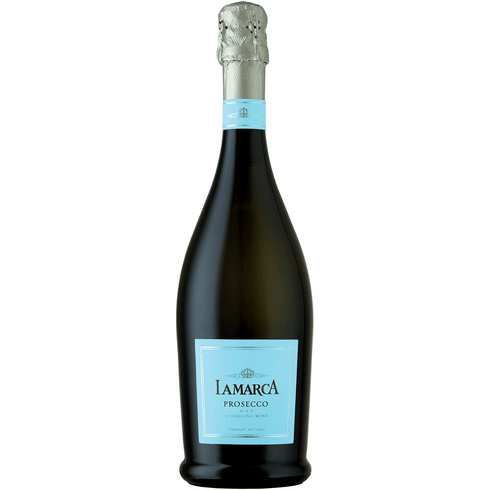
                                                    La Marca Prosecco 750ml

Prosecco producers worth the search: La Marca, Ruffino, Allini, Castello del Poggio, Mionetto, Zonin Cuvee, Da Luca, Bisol.

Whatever your preference for a celebratory sparkling wine, lift your glass high in a toast to a new and safer and more prosperous new year. 

                                                   -o0o-

Next Blog: Nebbiolo: Italy's King of Red Wine

Let me know what you think of this blog.  Email me at boydvino707@gmail.com.